
Commercial Water & Fire Damage Restoration
Large-loss protocols for office buildings, retail, mixed-use, and multi-family. Includes sprinkler discharge cleanup, containment zones, business-continuity documentation, and direct insurer coordination.
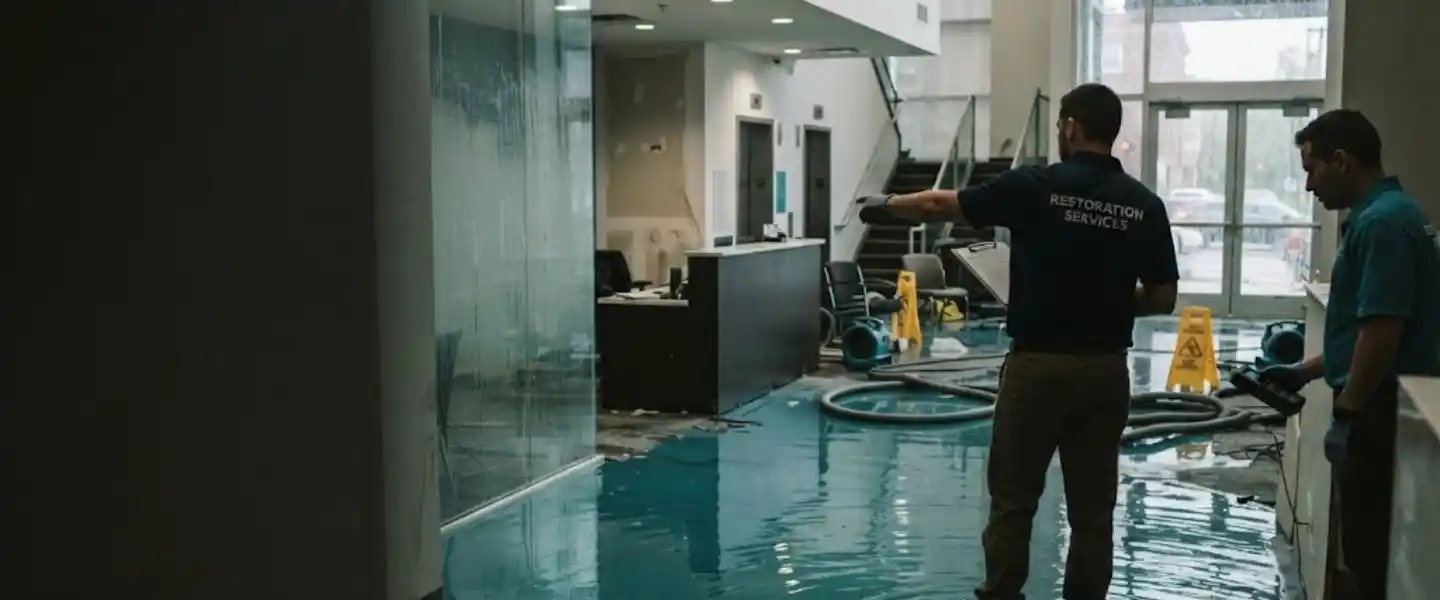
Water damage in Fairfax County's commercial corridors, high-density condo communities, and mixed-use buildings requires a different approach than a standard residential dryout. A sprinkler discharge in a Tysons office tower releases 20 to 40 gallons per minute per activated head. A ceiling failure in a 1970s Reston garden condo can trace back to shared plumbing three floors up. A sewage backup in a Merrifield multi-unit building triggers Category 3 biohazard protocols and property-management coordination that residential crews are not equipped to handle.
Fairfax Restoration Crew focuses on commercial, condo, and multi-unit scenarios across the city of Fairfax, Fairfax County, and the surrounding Northern Virginia corridor. We work directly with property managers, HOA boards, commercial insurers, and business owners - handling the documentation, access coordination, and large-loss drying protocols that these situations demand.
Reach us at (571) 741-6292 for structural and commercial damage calls around the clock.
Large-loss protocols for office buildings, retail, mixed-use, and multi-family. Includes sprinkler discharge cleanup, containment zones, business-continuity documentation, and direct insurer coordination.
When water migrates from the unit above through shared plumbing, overflowed appliances, or ice-dam intrusion, ceiling cavity drying and inter-unit documentation become the priority.
Commercial property policies, HOA master policies, and HO-6 condo coverage require different documentation packages. We build the adjuster file while the drying is underway.
Truck-mounted extraction, moisture mapping, structural drying phases, and dehumidification. The foundation of every water damage response, from a single suite to an entire floor plate.
Sump pump failure, groundwater intrusion, window-well flooding, and crawlspace events. Common in Fairfax County's clay-heavy soil after spring and summer storm events.
Category 3 water - toilet overflow, main sewer line backups, drain surges. Requires specialist PPE, ATP surface testing, and CDC-standard sanitation protocols.
Flash flooding, storm intrusion, water main breaks, and debris removal. Fairfax County's clay-heavy soil and Accotink Creek watershed create recurring stormwater events.
Supply-line failures, slab-leak water spread (damage only), and unattended-property freeze events. Fast extraction limits secondary mold growth in the 72-hour window.
Washer, dishwasher, and refrigerator supply-line failures. Water heater and boiler ruptures. In multi-story buildings, appliance floods reach units below within minutes.
HEPA containment, negative-air scrubbing, post-remediation clearance testing. In commercial and condo buildings, HVAC-spread mold requires building-wide assessment.
Structural assessment, firefighting-water extraction, smoke containment, board-up, and full reconstruction. Handles neighboring-unit fire scenarios in multi-family buildings.
Soot chemistry varies by fire type. Wet soot, dry soot, and protein residue each require different cleaning methods. HVAC spread to adjacent units addressed.
The building stock in Fairfax County and the surrounding Northern Virginia corridor spans six decades of construction. Each era has distinct water damage failure modes - and distinct restoration requirements.
| Building Type | Era | Common Failure Points | Key Service Areas |
|---|---|---|---|
| Garden condo / low-rise residential | 1960s–1980s | Aged galvanized or copper supply lines, shared masonry walls, crawlspace moisture accumulation, sump pump failures under clay-soil hydrostatic pressure | Annandale, Fairfax Circle, Springfield, Kamp Washington, Northfax |
| Mid-rise / office park / townhome HOA | 1990s–2000s | Wet-pipe sprinkler systems (accidental discharge), corporate-campus water events, HOA governance coordination, shared sewer stack backups | Reston, Herndon, Chantilly, Fair Oaks District, Oakton, McLean |
| Mixed-use / high-rise / transit-oriented | 2010s–present | Ground-floor retail plus residential above, complex HOA/commercial-tenant liability splits, sprinkler discharge volumes, inter-unit water migration through modern floor assemblies | Tysons, Mosaic District, Merrifield, Falls Church West, Dunn Loring |
Water damage events in condominiums and HOA communities in Fairfax and Northern Virginia involve multiple parties: the unit owner, the association, the property manager, and potentially the unit above or below. Virginia's Condominium Act (Virginia Code §55.1-1900 et seq.) establishes the legal framework for insurance responsibility, but the actual split between an HOA master policy and an owner's HO-6 policy depends on the source of the damage and the specific governing documents.
We carry the insurance certificates, licensing documentation, and HOA-submission materials that property managers require before authorizing work. Our crew respects building-specific work-hour restrictions, elevator scheduling, and debris removal rules. Call (571) 741-6292 and give us the property manager's contact - we handle the coordination.
Use our HOA vs. Owner Responsibility Checker for an educational overview of how these decisions typically break down - not legal advice, but a useful starting framework before you make calls.
Our service area covers the independent city of Fairfax, the full Fairfax County footprint, and adjacent Northern Virginia communities including Arlington. Each area we serve has its own building stock and commercial profile - the location pages cover the specific damage scenarios most common to each corridor.
We focus on commercial properties, condominiums, HOA communities, and multi-unit residential buildings across Fairfax city, Fairfax County, and adjacent Northern Virginia. That includes office buildings and corporate campuses, retail and mixed-use developments, garden-style and mid-rise condo complexes, townhome communities, and large residential buildings with shared plumbing and mechanical systems. We are equipped for large-loss drying that exceeds what residential restoration crews can handle.
Shut off the sprinkler supply valve if accessible and safe to do so, then call (571) 741-6292. A commercial-grade sprinkler head releases 20 to 40 gallons per minute - a five-minute activation can deposit 100 to 200 gallons or more in your space before the valve is closed. Extraction needs to begin as soon as possible to prevent structural saturation and secondary mold growth. Notify your property manager or building engineer in parallel; they will need to inspect the sprinkler system before re-pressurizing. We handle the documentation your commercial insurer will require.
Responsibility depends on the source of the water, your condo's governing documents, and which insurance policies apply. Generally, damage to your interior finishes falls under your HO-6 (condo) policy; the HOA's master policy covers common elements and shared building systems. If the water originated from a neighbor's appliance or plumbing, your insurer may subrogate against the neighbor's policy after paying your claim. The critical point: start drying immediately. Waiting for liability to be resolved allows moisture to migrate deeper into floor assemblies and wall cavities, raising costs for everyone. Our HOA vs. Owner Checker tool provides an educational framework, but review your specific governing documents for definitive answers. Call (571) 741-6292 and we can begin extraction while the paperwork is being sorted.
Yes. We document moisture readings daily, photograph scope progression, and provide pricing in the format commercial adjusters require. We communicate directly with your carrier or their third-party administrator throughout the claim. For large-loss events involving business-interruption coverage, we can assist with the operational impact documentation that supports BI claims, though the actual claim filing is handled by your broker or public adjuster. Call (571) 741-6292 to discuss your specific situation.
Mold can establish within 48 to 72 hours of a water event in the right conditions. In commercial buildings, the primary risk is HVAC-spread mold - if the system continued running during or after the event, spores may have migrated through ductwork to adjacent spaces. Our mold assessment for commercial and condo buildings includes air sampling, surface sampling where warranted, and a building-wide review of HVAC before scope is set. Remediation uses HEPA-filtered negative-air containment to prevent cross-contamination. Post-remediation clearance testing confirms the work is complete before the space is re-occupied. See our Mold Remediation and Mold Inspection & Testing pages for detailed process information.