Mold in a commercial building is an operations problem before it is a cleaning problem. The moment growth is visible in a Fairfax workplace, three clocks start running at once: the biological one, because active growth keeps spreading wherever moisture allows; the personnel one, because employees and tenants notice odors and start asking reasonable questions; and the paper one, because every decision made from that moment forward may need to be explained later. Fairfax Restoration Crew runs commercial remediation so that all three clocks get answered: contained work, clear communication material, and documentation from first assessment to clearance.
Why Commercial Mold Is Its Own Discipline
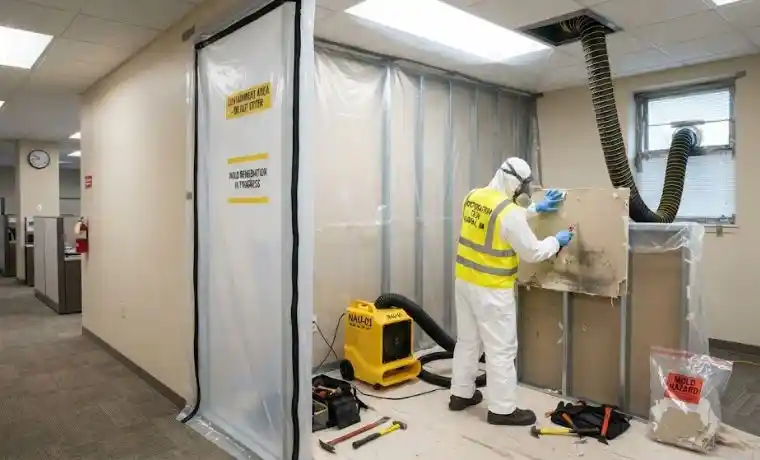
A house can be emptied for a week. An office building with tenants, leases, and payroll cannot. Commercial remediation has to happen around occupancy, which raises the standard for containment rather than lowering it. Work zones get isolated behind sealed containment with negative air pressure so that spores disturbed inside the zone stay inside the zone, following the IICRC S520 standard that governs professional mold remediation. Occupied floors keep working while the affected zone is stripped, cleaned, and verified. Done properly, most of the building never interacts with the work at all.
Where Commercial Buildings Grow Mold
The sources repeat across the Fairfax inventory. Roof membranes that leak slowly into ceiling insulation. HVAC condensate pans and lines that drip inside mechanical closets for months. Concealed plumbing in demising walls between suites. Below-grade walls in older buildings that wick ground moisture. And the aftermath of any water loss that was dried casually instead of to standard, which is why our water crews log final readings on every job: a documented dry structure is the cheapest mold prevention there is. Buildings along the Tysons corridor add long condensate runs and rooftop units serving deep floor plates; the garden-era stock around Annandale adds crawl spaces and original assemblies. The inspection maps the moisture source first, because remediation without moisture correction is a subscription, not a fix.
The Remediation Sequence
Assessment defines the affected area with moisture mapping and, where warranted, third-party sampling through mold inspection and testing. Containment goes up: sealed barriers, negative air machines exhausting through HEPA filtration, and controlled entry. Removal follows: porous materials with growth are removed and bagged inside containment; structural surfaces are cleaned with HEPA vacuuming and damp methods appropriate to the material. The moisture source gets corrected in the same scope. Then verification: the zone is inspected and, where the situation calls for it, cleared by an independent party before containment comes down. Every step lands in the file with photos and readings.
What Employers and Property Managers Get on Paper
Questions from employees, tenants, and boards deserve better answers than reassurance. The documentation package is built for exactly that audience: what was found and where, what moisture fed it, what was removed, how the work was contained, and what the post-remediation verification showed. It is factual and neutral by design. What it is not is health guidance or legal advice; concerns about occupant health belong with medical professionals, and disclosure or lease questions belong with your counsel. Our job is to make sure the underlying record they all rely on is complete.
Phasing Around a Working Building
Most commercial remediation in our coverage area runs nights, weekends, or zone-by-zone during business hours behind containment. Air handling serving the work zone is isolated so the HVAC system does not move spores while the work runs. Noise-heavy demolition gets scheduled against the tenant calendar. The framing is the same one we bring to every loss: stabilize the property, protect the asset, document everything. When growth is visible in your building, or a musty odor keeps returning to one zone, call (571) 741-6292 and describe it; assessment scheduling runs through the same 24/7 line as emergency dispatch, and for losses that started as water events, mold after water damage covers how the two scopes connect. The one wrong move is waiting for the odor to explain itself.
The Building Habits That Keep Us Away
Most commercial mold we remediate was preventable with three habits. Habit one: treat every water event as a documented event. A mopped-up leak with no moisture readings is a future mold call; a leak dried to standard with a final reading on file is closed business. Habit two: put mechanical closets and roof membranes on a real inspection cycle, because condensate lines and slow membrane failures are the two quietest moisture sources in the Fairfax inventory and both announce themselves through odor long after growth is established. Habit three: take tenant odor reports seriously the first time. A musty complaint that returns to the same zone is a moisture map waiting to be drawn, and drawing it early is an assessment visit instead of a containment project.
Property managers can put those habits on paper in an afternoon: a water event log, an inspection calendar, and a standing instruction that odor reports get a call to (571) 741-6292 rather than an air freshener. Buildings that run this way almost never meet our containment crews, which we consider the best possible outcome. Buildings that do not can at least meet us early: the difference between a closet and a floor plate is usually one budget cycle of waiting, and the assessment that settles it is one call to (571) 741-6292. Either way, the building wins when the moisture story is short, boring, and written down.
Commercial Mold Questions
Growth Visible or Odor Persistent?
Active mold spreads on moisture's schedule, not the tenant calendar. Call and get the assessment on the books.
(571) 741-6292