The first question every Fairfax business owner asks after a fire is the same: how long until we can reopen? The honest answer is that the fire itself is usually the smallest of the three problems standing between you and that date. A commercial fire loss is a fire problem, a water problem, and a smoke problem occupying the same address, and the reopening timeline is set by whichever one gets handled worst. Fairfax Restoration Crew runs all three as one scope, one crew lead, one file, starting from the first call to (571) 741-6292.
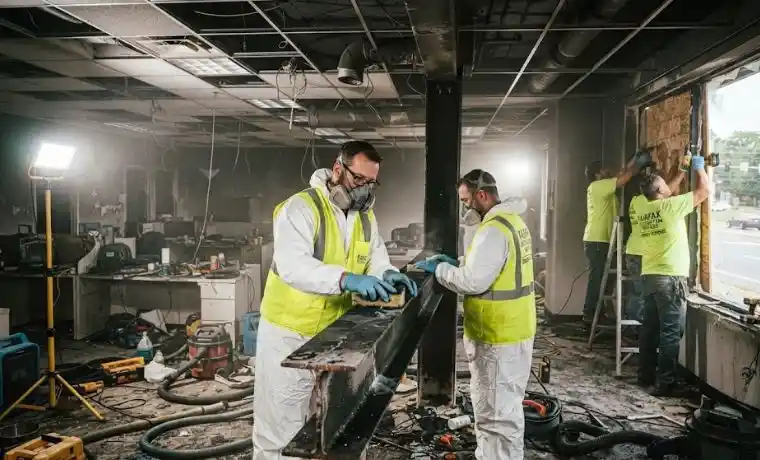
The Triple Scope of a Commercial Fire
Flame damage is visible and finite: what burned, burned. Suppression water is neither. Fire hoses deliver water by the hundreds of gallons per minute, sprinklers add their share, and all of it drains through the building on its own schedule, soaking floors the fire never touched. Smoke goes the other direction, riding heat and the HVAC system into suites and floors far from the origin. Two days after a contained kitchen fire in one tenant space, the loss map can cover half the building. That is normal, and the response has to assume it from hour one.
First Moves: Secure, Then Extract
Nothing starts until the fire marshal releases the scene. From there, stabilize the property: openings boarded, roof breaches tarped, utilities assessed, and the site secured, because an open commercial building attracts weather and people in equal measure. Our emergency board-up services crew handles that same day. Then the water: suppression water follows the same physics as any flood and gets the same urgency, extraction and drying against a moisture map, before saturated assemblies add a mold timeline to a fire timeline. The full water side of that work runs through water damage after firefighting.
Smoke and Soot on Commercial Surfaces
Soot is not dust; it is an acidic residue that keeps working on metal, electronics, and finishes for as long as it sits. Different fires leave different residues, and protein fires, plastics, and paper each clean differently, which is why blanket wiping by a janitorial crew reliably makes commercial smoke damage worse and why this is restoration work rather than cleaning work. HVAC systems that ran during the fire distribute residue through every space they serve, so duct assessment is part of scope, not an add-on. Odor gets addressed at the source through cleaning first; sealing and treatment come after, in that order.
Reopening in Phases, Not All or Nothing
Most commercial fire losses in Fairfax do not require the whole building to go dark until the last coat of paint. Unaffected suites can often reopen once systems and access are cleared. Damaged zones get contained and rebuilt while business continues around them. We sequence the work with the property manager so the highest-revenue spaces come back first, and the daily documentation shows insurers and lenders a defensible timeline. The framing we bring to every decision is the company voice line: stabilize the property, protect the asset, document everything. For office and retail specifics around the judicial center, Old Town Fairfax, and the Tysons corridor, the same crews that handle our commercial water work run the fire side.
Contents, Records, and the Claim
Commercial contents split three ways: restorable on site, restorable off site, and documented losses. Inventory happens as items move, with photographs and condition notes, through contents cleaning and restoration. Business records and electronics get triaged early because time and humidity work against both. Every reading, photo, and inventory line feeds one file, which is what your adjuster, your landlord or tenants, and your own decision making will run on for months. It starts with one call: (571) 741-6292.
What Actually Sets the Reopening Date
Owners assume the burn zone controls the timeline. In practice, four other clocks usually finish last. Structural drying of suppression water runs on material physics and cannot be argued with; it finishes when readings reach dry standard. Systems clearance, meaning electrical, mechanical, and fire protection sign-offs, waits on the specialty contractors and inspections your jurisdiction requires. Odor work cannot be certified done until residue removal and treatment have both finished and held. And procurement, the least dramatic clock, decides everything at the end: ceiling grid, flooring, and specialty finishes arrive when they arrive.
The way to compress the total is to run the clocks in parallel rather than in sequence, which is a coordination problem before it is a construction problem. Drying starts day one while board-up finishes. Contents move out while assessment continues. Long-lead materials get identified and ordered in the first week, not after demolition. This is the practical meaning of one scope and one crew lead: nobody waits on a phase that did not need waiting on. Ask dispatch at (571) 741-6292 for the crew lead assigned to your loss and you will get the same parallel-clock answer in more detail.
Commercial Fire Damage Questions
Fire Out. Clock Running.
Suppression water and soot both work against you by the hour. Call and board-up, extraction, and documentation start today.
(571) 741-6292