The fire was never in your unit. The trucks came for a neighbor two doors down or a suite on another floor, and your space never saw a flame. Yet a week later the odor is still in your closets, there is a gray film on the window sills, and in the worst version of this story, water from the suppression effort came through your ceiling while the fire itself stayed a hundred feet away. Neighboring-fire losses are a signature multi-unit problem, and in Fairfax's condo and office stock they land on our dispatch line at (571) 741-6292 every month.
How Smoke Reaches Units the Fire Never Touched
Buildings are connected in ways daily life hides. Corridors and stairwells carry smoke wherever doors were open during the event. Elevator shafts move it between floors. Shared HVAC and the plenum space above suspended ceilings distribute it laterally across suites that share nothing else. Utility penetrations between units leak it slowly. Smoke also follows heat and pressure, so it travels upward and toward cooler spaces, which is why units above and beside the fire unit routinely show more residue than units below it. None of this requires your door to have been open; buildings breathe, and during a fire they breathe smoke.
The Water Side Nobody Warns You About
Here is the part of a neighboring fire that surprises owners most: the water. Suppression delivers water in volumes no plumbing failure approaches, and every gallon that does not evaporate drains through the building by gravity, through floor assemblies, chases, and light fixtures into the units below and beside the fire. If your ceiling is wet after a neighbor's fire, you have a water loss with the same urgency as any burst pipe, layered under the smoke issue. That side of the loss runs exactly like our water damage from the unit above work: map the spread, extract, dry both sides of the assembly, and document, with the full picture covered under water damage after firefighting.
What Smoke Residue Does While You Wait
Soot residues are acidic and they keep working. Metals tarnish, plastics yellow, finishes etch, and fabrics hold odor deeper the longer residue sits. Different materials in the fire produce different residues, and each cleans differently, which is why the assessment identifies residue type before anyone wipes anything. The most expensive sentence in this category is: we cleaned it ourselves first. Household cleaning smears residue into finishes and sets stains that professional methods would have lifted, and it muddies the documentation of what the fire actually did to your unit.
Assessment, Cleaning, and Air
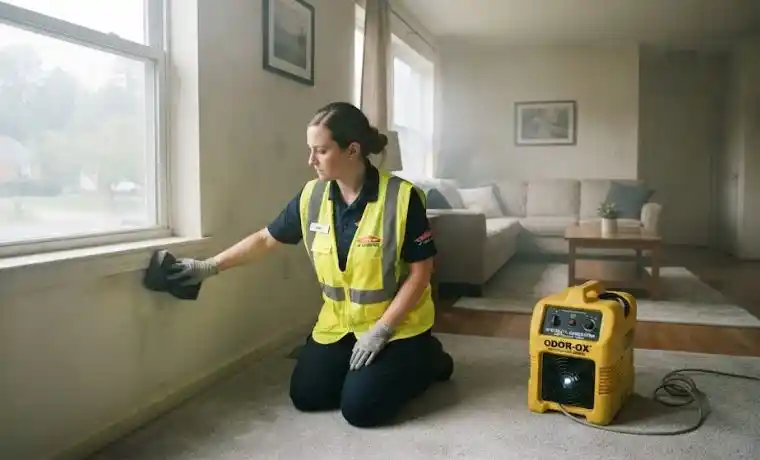
The response starts with a unit-by-unit assessment: where residue landed, what the HVAC moved, what the suppression water wet, all logged with photographs. Cleaning proceeds surface by surface with methods matched to residue and material, contents included through contents cleaning and restoration. Odor is handled at the source: residue removal first, then air scrubbing with HEPA filtration, then treatment of what remains, in that order, because deodorizing over residue is perfume, not restoration. Where the building's air handling served the fire area, duct assessment belongs in the scope before systems run normally again.
Documentation for a Loss You Did Not Cause
Your unit was damaged by an event that started somewhere else, which means your record has to stand on its own. The file we build is unit-specific: what reached your space, by what path, what it affected, what was cleaned or removed, with readings and photos throughout. Owners hand it to their carrier; commercial tenants hand it to landlords and insurers; associations get the neutral version of events they need when several units claim from one origin. Whose policy responds and how is between the carriers and, where needed, your own advisors; we stay out of that entirely and make sure the facts are unarguable. If the trucks just left and your unit smells like someone else's fire, call (571) 741-6292 and get the assessment scheduled while the evidence is fresh.
Access, Timing, and the Association
Neighboring-fire losses run through more doors than any other loss type. Your unit needs assessment, but so does the corridor, the shared plenum, and sometimes the HVAC serving your floor, and those spaces belong to the association or the building owner. The practical sequence: report your damage to management in writing early, ask that common-element assessment be coordinated with unit assessments so the record covers the whole smoke path, and get your own unit documented even if the building's process moves slowly. Your file stands alone by design, so a slow association timeline does not erode your evidence.
Timing has one more wrinkle worth knowing: fire-origin units draw the attention first, and neighbors who wait politely for that work to finish often discover their own residue has been etching finishes for a month. Assessment of your unit does not interfere with restoration of theirs, and running both on parallel tracks is normal, not pushy. Multi-unit coordination, association walkthroughs, and phased scheduling across several affected units all run through the same dispatch line at (571) 741-6292, and one crew lead carries the whole event so the story stays consistent across every door it touched.
Neighboring-Fire Damage Questions
Neighbor's Fire. Your Damage.
Residue keeps etching and hidden water keeps soaking whether or not the fire was yours. Call and get your unit assessed.
(571) 741-6292