Claims are decided on paper, and on very little else. Two identical water losses in two identical Fairfax buildings can settle months and thousands of dollars apart for one reason: what got documented in the first seventy-two hours. Adjusters were not standing in the water with you. They reconstruct the loss from photographs, moisture readings, drying logs, and scope, and where the record is thin, the reconstruction runs conservative. Fairfax Restoration Crew builds the record insurers actually use, starting with the first reading on the first visit, on every loss dispatched through (571) 741-6292.
What This Page Is and Is Not
Let this be plain: we are a restoration contractor, not a public adjuster, insurance agent, or law firm. We do not interpret policies, negotiate settlements, or advise on coverage, and anything here is general information rather than advice for your specific claim. What we do is produce the factual record a claim runs on and coordinate access, readings, and scope questions with your adjuster so the process moves. Coverage questions belong with your broker or carrier; dispute questions belong with the professionals who handle disputes.
The Commercial Claim Has More Moving Parts
Commercial property policies commonly separate the building, business personal property, and, where purchased, business interruption coverage that responds to lost income during restoration. Add a landlord policy, tenant policies, and in condominiums a master policy sitting over unit policies, and a single stacked-unit loss can involve four or five carriers reading the same event. Every one of them works from documentation. A neutral, timestamped record of where water traveled and what it wet is the one artifact that serves every party at the table, which is exactly why we build it that way.
What the First 72 Hours Should Produce
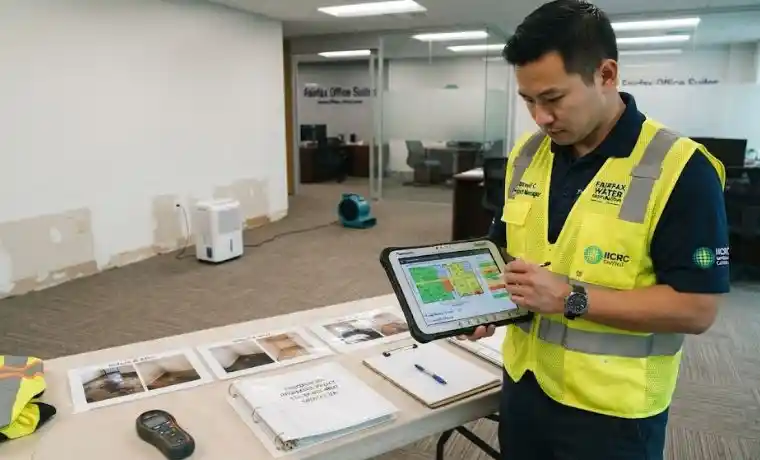
Photographs before anything is moved, then at every phase. Moisture readings by location and material on arrival, then daily until dry standard, because the drying log is what proves both the extent of the loss and the diligence of the response. Thermal imaging where water traveled inside assemblies. An equipment log showing what ran where. A scope that maps to the readings rather than to a template. And for businesses tracking downtime, the timeline entries that show when zones closed and reopened. This is the standard file on our commercial and condo losses, described further under commercial water damage restoration.
Where Claims Go Sideways
The patterns repeat. Cleanup starts before photographs exist, so the worst of the loss is never on record. Materials get discarded without documentation, leaving nothing to show the adjuster. Drying is declared done without final readings, and a mold finding two months later has no baseline to argue from. Or mitigation waits for a coverage answer, and the delay itself becomes the dispute, since policies commonly expect reasonable steps to prevent further damage. The repair for all of these is the same: document first, mitigate promptly, keep everything, and let the paper do the arguing. Our crews are trained to protect discarded materials documentation, moisture baselines, and timeline integrity without being asked.
How We Work With Your Adjuster
We schedule joint walkthroughs, provide the file in whatever format the carrier uses, answer scope questions with readings rather than opinions, and flag where hidden damage justifies opening assemblies before the scope closes. Property managers running losses across several buildings, including associations around Fairfax Circle and offices along the Tysons corridor, get one point of contact and a consistent file format across every loss. The voice line applies here more than anywhere: stabilize the property, protect the asset, document everything. If a loss just happened and the claim clock is already running, call (571) 741-6292 and get the record started before anything else moves.
A Record You Can Start Before the Crew Arrives
The minutes before our arrival are documentation minutes if you use them. Photograph wide first, then close: every affected room from its doorway, then the water source, the waterline on walls, serial plates on affected equipment, and inventory as it stands. Video a slow walkthrough narrating the time and what you see; timestamps do quiet work in a file. Note when the loss was discovered, when water was shut off, and who was notified, with times. Save everything wet that gets moved rather than discarding it, and if something must be thrown out for safety, photograph it first from two angles.
Do not start tearing out materials, and do not run shop vacuums through Category 2 or 3 water; both destroy evidence and one is a health matter. The goal of your twenty minutes is a timestamped baseline the professional record then builds on without a gap. Dispatchers at (571) 741-6292 will tell you, for your specific loss, which of these steps matter most while the crew is en route, and the crew lead folds what you captured into the file so the baseline is continuous from your first photo to the final reading.
Insurance Documentation Questions
Loss Happened. Claim Clock Running.
The record that decides your claim gets built in the first days. Call and start it now.
(571) 741-6292