
Commercial Damage | Business Downtime | Northern Virginia
Commercial Building Water Damage in Northern Virginia: Minimizing Business Downtime
- Fairfax Restoration Crew
For commercial tenants and building owners in Tysons, Merrifield, Herndon, Reston, and the broader Northern Virginia office market, water damage is not just a property problem - it is a revenue problem. Every day a commercial space is out of service represents direct income loss, contract-compliance risk for federal and technology contractors, and customer disruption costs that extend beyond the restoration bill. Minimizing business downtime starts with decisions made in the first hour after a water event is discovered, not after the restoration contractor finishes.
The Cost-Per-Day Reality for Northern Virginia Commercial Tenants
Business interruption costs in the Northern Virginia office market vary by tenant type, but the baseline math is straightforward: average daily revenue divided by the number of closure days. For a 50-person professional services firm in a Tysons office, $50,000 per day in billable activity is a reasonable baseline. Five drying days equals $250,000 in potential BI exposure - against a restoration bill that may be $30,000 to $80,000 for the same event. The restoration cost is almost never the largest number in a commercial water damage event. Use our Business Water Downtime Cost Calculator for a framework estimate specific to your situation.
Decisions That Shorten Drying Time
The primary lever for reducing closure duration is the speed and completeness of extraction. Every hour of delay between water intrusion and extraction allows moisture to migrate deeper into structural assemblies - which requires longer drying times or more demolition to address. A water event discovered Monday morning that receives immediate extraction the same day will have a meaningfully shorter drying timeline than the same event discovered Monday morning that receives extraction on Tuesday because the property manager was delayed in authorizing a contractor. Call (571) 741-6292 immediately; authorization and extraction can run in parallel.
The second lever is selective demolition. Saturated drywall that is removed within 24 to 48 hours allows the structural framing behind it to dry to target moisture content in 3 to 5 days. The same saturated drywall left in place requires the full assembly to reach equilibrium - potentially 10 to 14 days or longer. For commercial tenants, removing and replacing 200 square feet of drywall adds 2 to 3 days to reconstruction but may save 7 to 10 days of drying time. The math almost always favors early selective demolition.
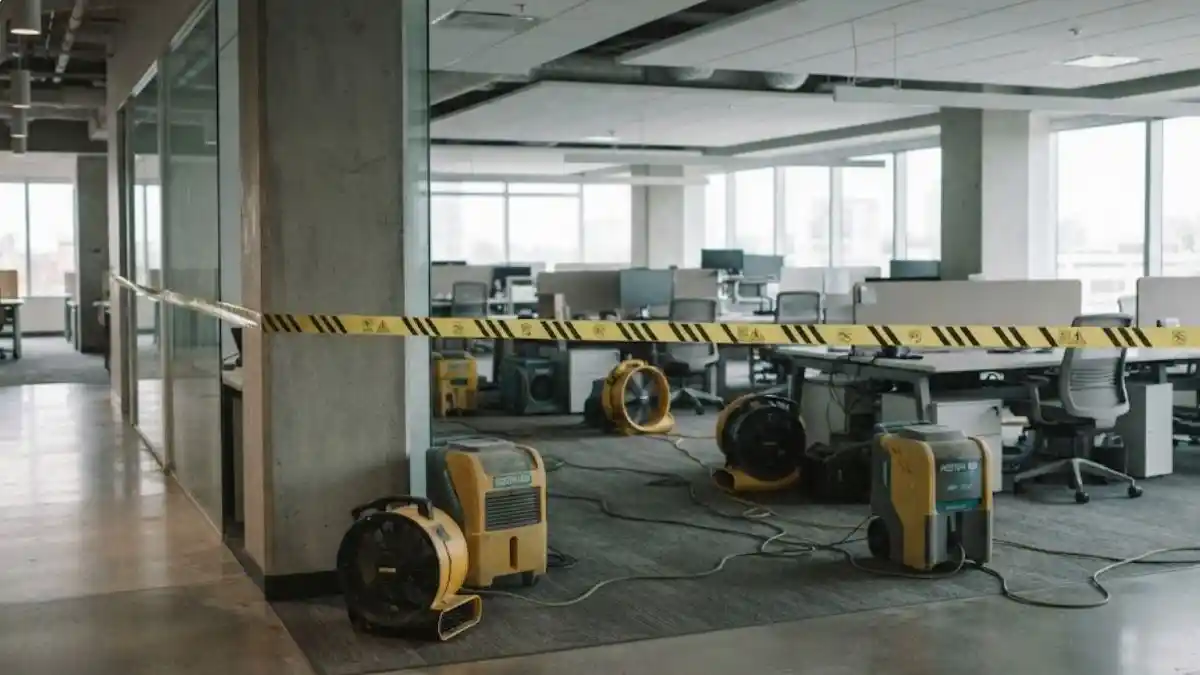
The third lever is equipment scale. Commercial drying equipment - low-grain refrigerant dehumidifiers rated for 150+ pints per day and high-velocity air movers - shortens drying time by maintaining the evaporative conditions (low ambient humidity, directed airflow) that drive moisture from structural materials into the air. Undersized equipment extends drying time proportionally. For large Northern Virginia office floor plates, multiple drying zones running simultaneously is the standard commercial approach.
Scheduling Drying Around Business Operations
For tenants who need to maintain partial operations during restoration, drying zones can be established that isolate the affected area while allowing unaffected portions of the floor plate to remain operational. This requires advance planning with the property manager and the restoration contractor: containment barriers, separate HVAC isolation for the drying zone, and noise management for drying equipment operating near occupied spaces. Call (571) 741-6292 to discuss a phased drying plan that accommodates your operational requirements.
Business-Interruption Insurance Documentation
A well-documented BI claim requires two parallel streams: the physical restoration timeline (what work was done, when decisions were made, when drying was verified complete) and the financial impact documentation (revenue, contracts affected, costs incurred). We provide the physical restoration timeline - daily moisture logs, scope decisions with dates, equipment placement, and final drying verification. Your accountant and insurance broker handle the financial documentation. Bring them into the conversation early - the sooner your BI insurer is notified, the sooner the coverage period clock starts.
For federal contractors in Herndon, Chantilly, and Springfield, water damage that interrupts government contract performance may have contract notification requirements separate from the insurance claim. Review your contract's force majeure and business continuity provisions and notify your contracting officer's representative as appropriate. Our documentation can support the contract-notification process as well as the insurance claim. See Commercial Damage Restoration for the full large-loss protocol. Call (571) 741-6292.
The Landlord-Tenant Question
In leased commercial space, the question of who is responsible for the water damage and who controls the restoration timeline depends on the lease. Many commercial leases in Northern Virginia place restoration responsibility with the landlord for building-system failures and with the tenant for damage caused by tenant activities or equipment. The lease may also define the landlord's timeline obligations for completing restoration - an important point when BI coverage depends on the actual closure duration. Review your lease before the water event if possible; if you are in an active event, call your commercial attorney for a rapid read on the relevant lease provisions while restoration begins. Call (571) 741-6292 for commercial water damage across the Northern Virginia corridor.
Questions about your situation? Call (571) 741-6292 - Fairfax Restoration Crew serves commercial properties, condos, and multi-unit buildings across Fairfax VA, Fairfax County, and Northern Virginia.