
Smoke & Soot Residue
Soot is not a uniform substance - its chemical composition, particle size, and adhesion characteristics differ dramatically depending on what burned and how it burned. The wrong cleaning method for the soot type in your space does not remove the residue; it spreads and embeds it. This is why smoke and soot damage that is "wiped down" by occupants or general cleaning crews before a professional assessment often costs more to restore than damage that was left untouched for our technician to evaluate first. Call (571) 741-6292 before touching any soot-affected surface. Our Smoke & Soot First-Steps Checklist covers safe actions in the first two hours.
Soot Chemistry - Three Types, Three Cleaning Protocols
Wet Soot - Grease and Low-Oxygen Fires
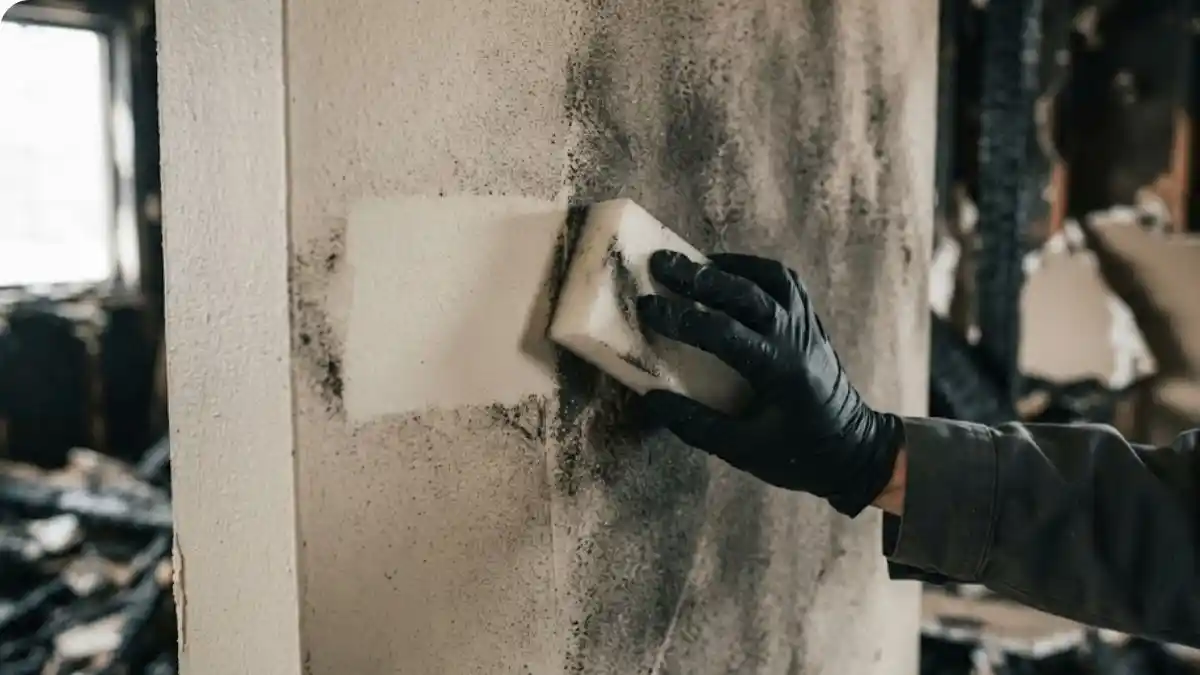
Wet soot is produced by smoldering, low-oxygen fires - primarily grease fires in kitchen environments and fires involving synthetic materials that burn slowly. It has a tar-like consistency, strong odor, and extremely high surface adhesion. Wet soot smears when wiped with dry materials; the smearing motion embeds soot particles deeper into porous surfaces and extends the cleaned area's discoloration. The correct cleaning approach uses chemical sponges or specific alkaline cleaning agents that break the soot's adhesion bond before mechanical removal. Wet soot on soft furnishings and contents may be beyond cleaning threshold and require replacement. Call (571) 741-6292 for grease fire and wet soot situations.
Dry Soot - Fast-Burning, High-Oxygen Fires
Dry soot is produced by fast-burning fires with adequate air supply - paper, wood, and electrical fires typically produce dry soot. It is fine and powdery, does not smear as readily as wet soot, but is extremely mobile and distributes widely through air movement and HVAC systems. The challenge with dry soot is scope: a kitchen fire that produces dry soot may deposit visible residue on surfaces in rooms two and three doors away from the fire origin. In commercial buildings with shared HVAC returns, dry soot distributes across the entire air-handler zone before the system is shut down. HEPA vacuum removal before wet cleaning is the standard protocol - wet cleaning dry soot without vacuuming first spreads the residue. Call (571) 741-6292 for electrical fires and other dry-soot events.
Protein Residue - Cooking Fires Without Visible Flame
Protein fire residue is the most commonly missed soot type. It is produced when food items - meat, fish, dairy - overheat and vaporize without significant visible flame. The residue is nearly invisible on most surfaces: it appears as a slight discoloration on walls and ceilings and may not register as fire damage at first inspection. However, it produces an extremely persistent odor - the characteristic smell of an overheated kitchen that lingers for weeks - and bonds tightly to surfaces because the protein molecules denature and adhere at the molecular level. Standard cleaning methods are ineffective; specialized enzymatic or oxidizing cleaning agents are required. If you have a kitchen fire or severe overcooking event with persistent odor but no visible soot, protein residue is likely the explanation. Call (571) 741-6292.
HVAC Spread - How Soot Reaches Unaffected Areas
In any building where the HVAC system was running during or after the fire event, smoke and soot particles travel through the return-air path and are distributed across the full zone served by that air handler. In a typical Fairfax County condo building with a shared air-handler serving multiple units, this means soot from a fire in Unit 4B may deposit on surfaces in Units 4A, 4C, and the fourth-floor corridor before the system is shut down - without those occupants being aware of a fire event.
Post-fire HVAC assessment covers: duct lining and filter condition (soot-loaded filters must be replaced immediately; activated carbon filters help with odor but do not remove deposited soot from duct surfaces), supply and return register cleaning, and in severe cases, full duct cleaning by a certified duct cleaning contractor. We assess the HVAC system as part of the initial scope and flag duct cleaning where warranted. In commercial buildings with large air handlers serving entire floors, HVAC shutdown at the moment of fire detection significantly limits soot spread. Call (571) 741-6292 for multi-unit or commercial HVAC soot spread situations.
Puffback - Oil Furnace Soot Events
Puffback is a specific soot event associated with oil-fired furnaces: a misfire in the combustion chamber causes unburned oil to accumulate and then ignite suddenly, pushing a burst of oily soot back through the furnace's air distribution system and into the living or working space. The result is a spray pattern of oily, sticky soot across walls, ceilings, and contents in every room served by the heating system - often appearing overnight when the furnace cycles during a cold period. Puffback soot is wet soot with an oil component: it has both the adhesion characteristics of wet soot and the penetration depth of oil-based contaminants in porous materials.
Puffback events are most common in Fairfax County's older residential and commercial stock that still uses oil heat - portions of Great Falls, McLean, and older Falls Church residential - particularly after periods of furnace disuse, oil delivery after running near-empty, or following service that introduces air into the fuel line. The furnace must be serviced and confirmed safe by a qualified HVAC technician before heating is restored; our scope is the soot cleanup that results. Call (571) 741-6292 for puffback situations.
Soot Cleaning in Multi-Unit Buildings - Adjacent Unit Scenarios
When a fire occurs in a neighboring condo or apartment unit, smoke migration through shared walls, HVAC connections, and corridor penetrations affects adjacent units with no direct fire damage. The soot in an adjacent unit is typically dry soot that has traveled through penetrations and HVAC paths - its distribution pattern is different from the soot at the fire origin, and its cleaning protocol is the same dry-soot approach: HEPA vacuum first, then surface cleaning, then odor treatment. For the full adjacent-unit fire scenario from a restoration standpoint, see Fire Damage Restoration. For odor treatment after the soot is cleaned, see Smoke Odor Removal. Call (571) 741-6292 if your unit received smoke from a neighbor's fire.
Do's and Don'ts Before the Crew Arrives
| Action | Why |
|---|---|
| DO shut off HVAC immediately | Stops soot distribution through duct system to unaffected areas |
| DO open windows briefly to ventilate (if safe) | Reduces airborne particle concentration; limits respiratory exposure |
| DO photograph all affected surfaces before anything is touched | Establishes documentation baseline for insurance claim |
| DON'T wipe soot with dry cloths or paper towels | Smears and embeds soot into surfaces; dramatically increases cleaning cost |
| DON'T run fans or portable air purifiers | Redistributes dry soot particles to previously unaffected surfaces |
| DON'T wash soot-covered walls with household cleaners | Wrong chemistry for soot type may set the residue permanently |
| DON'T attempt to clean electronics | Soot inside electronics causes shorts; professional cleaning required before power-on |
Use our interactive Smoke & Soot First-Steps Checklist for a guided sequence of safe actions. Call (571) 741-6292 for soot cleanup in any Fairfax VA or Fairfax County property.
Smoke and Soot FAQ
-
The scope depends on whether the HVAC was running during the event and how far the smoke traveled. For a contained grease fire where the kitchen vent caught most of the smoke and the HVAC was off, professional cleaning may be limited to kitchen surfaces, cabinets, and adjacent areas. If the HVAC was running, dry soot may have distributed significantly further. We assess the actual spread with a visual inspection and recommend cleaning scope based on what is present - not a default whole-house protocol. Call (571) 741-6292 for an assessment.
-
First: shut off the furnace and do not restart it until an HVAC technician has inspected and repaired the combustion chamber. Second: do not touch the soot or attempt any cleaning. Third: call (571) 741-6292. Puffback soot is oily and very easy to spread with incorrect handling. The cleaning scope in a puffback event typically covers every room served by the heating system - which in most Fairfax County residential properties means the entire living space. Contents including furniture, fabrics, and electronics may also require professional cleaning. Document with photographs before we arrive.
-
Not necessarily. Odor perception varies by individual, and smoke compounds that cause odor can temporarily be masked by ventilation and then return as temperatures rise or humidity changes. Additionally, soot residue that does not produce a strong smell may still be present on surfaces and can cause respiratory irritation over time. Completion of soot cleaning is verified by visual inspection under good lighting and, where warranted, air quality testing - not by odor alone. For persistent odor after cleaning, see Smoke Odor Removal for the neutralization protocols we use. Call (571) 741-6292.