
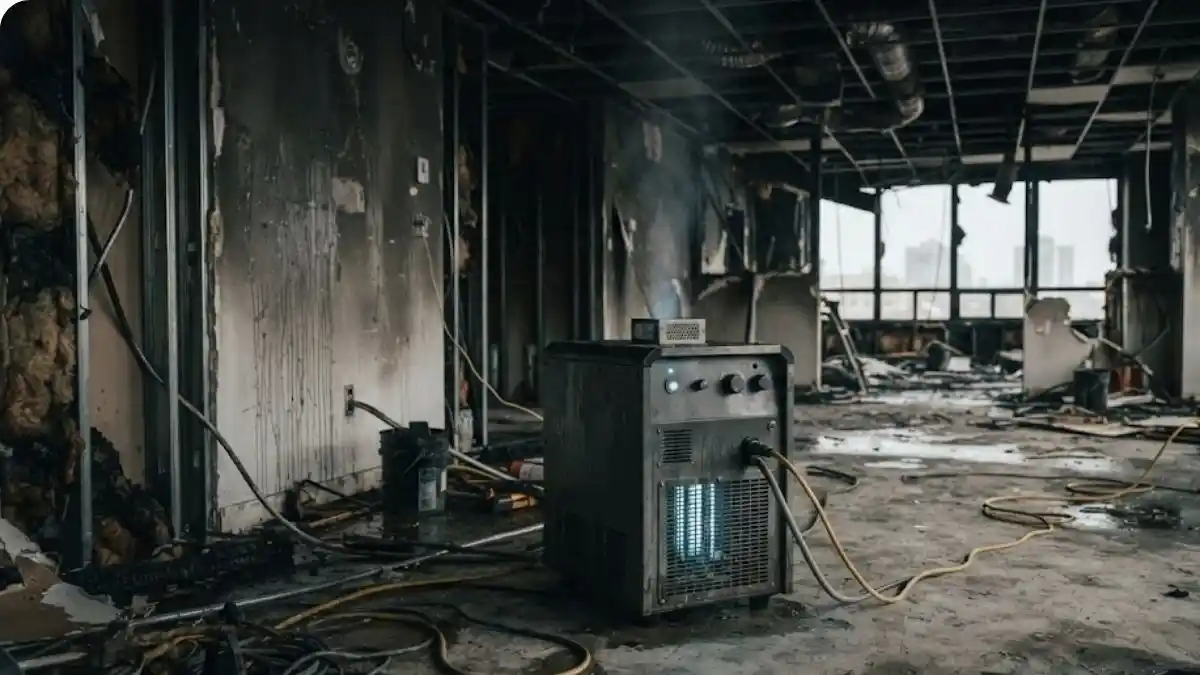
Odor Neutralization
Smoke odor that persists after visible soot has been cleaned is not a cleaning problem - it is a chemical neutralization problem. Smoke compounds penetrate porous building materials at the molecular level: drywall, framing lumber, carpet backing, cabinet interiors, HVAC duct lining. Surface cleaning removes the visible residue; it does not neutralize the odor compounds that have bonded to the material structure. Masking agents - scented sprays and air fresheners - suppress perception temporarily but do not eliminate the source. Odor returns when temperatures rise or the masking compound dissipates. Professional odor removal requires chemical or photochemical oxidation of the odor compounds where they reside. Call (571) 741-6292 for smoke odor situations in Fairfax VA, Fairfax County, and Northern Virginia.
Three Odor Removal Methods - How Each Works
Ozone Treatment
Ozone generators produce ozone (O3) by electrical discharge - the same chemistry as lightning in a thunderstorm. Ozone is an aggressive oxidizer: it reacts with and breaks down organic compounds, including the aldehydes, phenols, and other volatile organic compounds that make up smoke odor. Ozone penetrates porous materials and reaches odor compounds in wall cavities, carpet backing, and HVAC duct surfaces that surface cleaning cannot reach.
Ozone treatment requires the space to be vacated during treatment - ozone at the concentrations needed for odor neutralization is harmful to people, pets, and plants. Treatment duration depends on the severity of odor and the space volume, typically 2 to 8 hours followed by an airing-out period before re-occupancy. Ozone also degrades certain rubber and latex materials at prolonged exposure; we protect or remove vulnerable items before treatment. Call (571) 741-6292 to schedule ozone treatment for your Fairfax County property.
Thermal Fogging
Thermal foggers heat a petroleum-based deodorizing solvent to produce a dense fog of fine droplets that behave physically like smoke - penetrating the same paths through wall penetrations, under doors, through HVAC systems, and into porous surfaces that the smoke originally followed. The fog droplets carry deodorizing agents that pair with and neutralize odor compounds where they are embedded. Thermal fogging is particularly effective for smoke that has penetrated deep into porous materials and traveled through HVAC pathways, because the fog follows the same distribution pattern as the original smoke event.
Like ozone treatment, thermal fogging requires vacating the space during application and a ventilation period afterward. It is often combined with ozone treatment for severe odor cases - the thermal fog reaches the distribution points first, and the ozone treatment addresses residual compounds afterward. Call (571) 741-6292 for thermal fogging in commercial and multi-unit Fairfax County buildings.
Hydroxyl Generation
Hydroxyl generators produce hydroxyl radicals (OH) through UV light interaction with water vapor, simulating the natural atmospheric chemistry that breaks down organic compounds outdoors. Hydroxyl radicals are more reactive than ozone and degrade a wider range of volatile organic compounds. The significant operational advantage of hydroxyl generation is that it can be run continuously in occupied spaces - people, pets, and sensitive materials can remain present during treatment. This makes hydroxyl generation the preferred method for commercial spaces that cannot be fully vacated, and for multi-unit buildings where full-building evacuation is not practical.
Hydroxyl treatment is slower than ozone or thermal fogging for severe odor cases - it may run for 24 to 72 hours to achieve the same neutralization that ozone achieves in a shorter unoccupied treatment. For moderate odors in occupied commercial spaces in Tysons, Merrifield, or Reston Town Center where business continuity matters, hydroxyl is the practical choice. Call (571) 741-6292 to discuss which method fits your situation.
| Method | Occupancy During Treatment | Best For | Typical Duration |
|---|---|---|---|
| Ozone | Vacate required | Severe odor, unoccupied residential or commercial space, puffback events | 2-8 hours treatment + airing |
| Thermal Fogging | Vacate required | Odor that followed smoke pathways through walls and HVAC; used with ozone for severe cases | 1-3 hours treatment + ventilation |
| Hydroxyl | Occupied safe | Commercial spaces that cannot vacate; moderate odors; sensitive contents (electronics, artwork) | 24-72 hours continuous |
Odor Sources Requiring Treatment After Soot Cleaning
Post-Fire Smoke Odor
After soot cleaning is complete on visible surfaces, smoke odor compounds remain in wall cavities, ceiling assemblies, subfloor, and HVAC ductwork. Odor treatment follows soot cleaning - not as a substitute for it. Running odor treatment without completing soot cleaning first is counterproductive: the remaining soot deposits continue to off-gas odor compounds faster than the neutralization equipment can process them. The correct sequence is always: soot cleaning first, odor treatment second. Call (571) 741-6292 for post-fire odor in Fairfax VA commercial and condo properties.
Puffback Odor - Oil Furnace Events
Puffback odor is among the most persistent smoke-related odors because the oil-based soot compounds have a very high boiling point - they volatilize slowly over time, releasing odor continuously for weeks after the event. Standard ozone treatment after puffback soot cleaning is usually the most effective approach. For severe puffback events affecting the full HVAC distribution zone, thermal fogging through the furnace supply registers follows soot cleaning and precedes ozone treatment. The furnace itself must be professionally serviced before any odor treatment begins. Call (571) 741-6292 for puffback odor in Fairfax County properties.
Neighbor-Fire Smoke Migration in Condos
Adjacent units that received smoke migration from a neighboring fire often have odor without significant visible soot. The odor compounds have penetrated soft furnishings, HVAC ductwork, and porous wall surfaces through shared penetrations. For condo units where the odor is the primary complaint and soot loading is low, hydroxyl generation run continuously over 48 to 72 hours is typically the first approach. If odor persists after hydroxyl treatment, thermal fogging of the HVAC pathways followed by ozone treatment of the space is the escalation path. Call (571) 741-6292 for adjacent-unit smoke odor in Fairfax County condo communities.
HVAC System Odor - When Ductwork Holds the Smell
When smoke has traveled through an HVAC system, the duct lining - fiberglass duct board is particularly absorptive - retains odor compounds that are released every time the system cycles. This is the explanation for smoke odor that returns after treatment: the space surfaces have been neutralized, but the HVAC is re-contaminating the air on every heating or cooling cycle. Addressing HVAC-retained odor requires either professional duct cleaning followed by thermal fogging of the duct system through the supply registers, or in severe cases, replacement of duct lining sections. We assess HVAC odor retention as part of the post-treatment evaluation and recommend duct cleaning where the system is the residual odor source. Call (571) 741-6292.
Odor Removal FAQ
-
Because the odor source is inside the materials, not on the surface. Airing out removes airborne compounds and some surface-level off-gassing, but odor compounds that have bonded with drywall paper, carpet backing, upholstery foam, and wood continue releasing volatile compounds over time - more quickly as temperatures rise. Surface cleaning removes visible residue but does not reach the bound compounds inside porous materials. Only oxidative treatment (ozone, hydroxyl) or thermal fogging neutralizes the compounds where they reside. Call (571) 741-6292.
-
At the concentrations used for odor treatment, ozone can degrade rubber seals and gaskets over prolonged exposure, and some latex materials. Electronics themselves are not significantly affected by short-duration ozone exposure, but should be removed or covered if the treatment duration exceeds several hours as a precaution. Natural rubber items (bands, gaskets, some keyboard feet) should be protected or removed. We conduct a pre-treatment walkthrough to identify and protect vulnerable items. For spaces with sensitive electronics or materials that cannot be removed, hydroxyl generation is the safer alternative. Call (571) 741-6292 to discuss your specific situation.
-
Hydroxyl generation is the primary option for occupied commercial spaces - it is safe for continuous operation in occupied environments. For moderate odors, hydroxyl treatment running over 48 to 72 hours achieves effective neutralization without requiring evacuation. For more severe odors in a commercial space that cannot afford extended downtime, a combination approach is possible: hydroxyl during business hours, ozone after hours in sections of the space that can be isolated and vacated overnight. We schedule around your operational requirements. Call (571) 741-6292 to discuss a treatment plan for your Fairfax County commercial property.