
Basement & Crawlspace
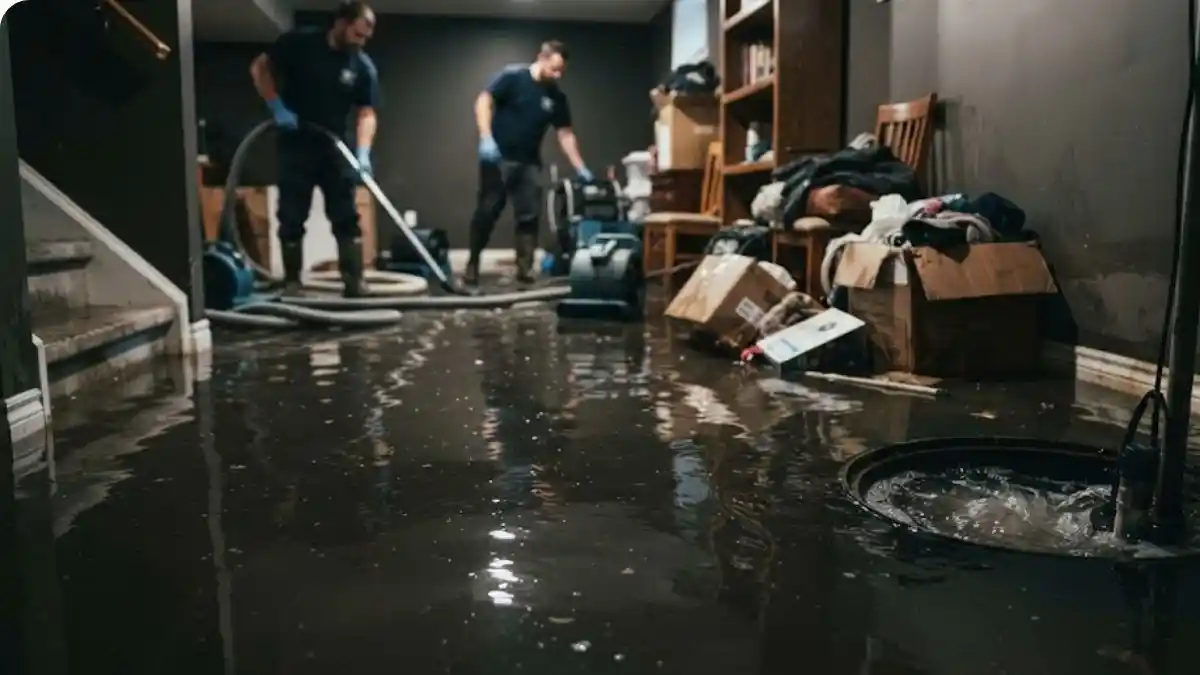
Fairfax County's clay-heavy soil does not drain well. During heavy rain events - the county averages about 42 inches of precipitation annually, with significant convective events in spring and summer - that clay soil becomes saturated quickly, builds hydrostatic pressure against foundation walls and floor slabs, and pushes water inward through cracks, joints, and window-well drains that cannot keep pace with the volume. A sump pump that fails during a storm event, or a window well without an adequate drain, can deposit several inches of water in a finished basement in under an hour. Call (571) 741-6292 for basement flooding situations across Fairfax VA, Fairfax County, and the surrounding area.
Sump Pump Failure - The Most Common Basement Flood Trigger
The majority of basement flood calls in Fairfax County during storm events trace back to sump pump failure. The pump runs continuously during heavy rain, overheats, or loses power (often when storms knock out electricity, eliminating the pump at the exact moment demand is highest). Battery backup systems help but have limited capacity. When the pump fails, water accumulates in the sump pit and overflows into the basement floor within minutes in high-water-table conditions.
The water from a sump failure is typically Category 1 or Category 2 depending on what the pit collects - clean groundwater is Category 1; if the pit is shared with floor drain discharge or the pit has significant soil contamination, the water may classify higher. The extraction and drying process is the same as any clean-water basement event: standing water out first with truck-mounted extraction, moisture mapping to establish the extent of wall and floor saturation, dehumidification and airflow drying of the structural materials, and targeted drying of any stored materials that can be saved. Finished basement drywall that has absorbed groundwater for more than 24 to 48 hours typically must be removed to dry the framing and insulation behind it.
Groundwater Intrusion - Foundation Walls and Floor Slabs
Hydrostatic pressure from saturated clay soil pushes water through foundation wall cracks, floor slab cracks, and the wall-floor joint (cove joint) - even in basements with no previous flooding history, when a sufficiently heavy rain event follows a dry period. The dry period allows the soil to pull away from the foundation slightly; the subsequent rain saturates the soil rapidly and directs high-pressure water toward the new gap. This pattern is particularly pronounced in Fairfax County's older residential neighborhoods - Kamp Washington, Northfax, parts of Fairfax Circle, and the 1960s-70s subdivisions in Annandale and Springfield - where original waterproofing and drainage systems have aged beyond their design life.
Groundwater intrusion through masonry walls requires drying the wall assembly from both faces where possible. Masonry and concrete absorb water significantly - a concrete block wall can hold several pounds of water per square foot of surface area. Drying masonry takes longer than wood framing: 10 to 21 days is a realistic range depending on thickness and initial saturation level. Structural damage from chronic groundwater intrusion - efflorescence, spalling, mortar joint erosion - is outside our restoration scope and requires a structural engineer or waterproofing contractor to address the source. We address the water that is present now. See Flooded Basement in Fairfax After a Storm: Sump Pump Failure vs. Storm Drain Backup for a detailed breakdown of the two cause types.
Window-Well Flooding
Below-grade windows surrounded by window wells are a common entry point in Fairfax County's split-level and raised-ranch construction from the 1960s and 70s. The window well drain at the base of the well must be kept clear of debris; when it clogs, the well fills with rainwater and the weight of water against the window frame forces entry at the window seal or directly through the glass if the frame is compromised. Window-well flooding is a localized but concentrated event - the water volume entering through a single window well in a heavy rain event can be substantial, and it deposits in a confined area that tends to be the most finished part of the basement (bedrooms, family rooms).
The extraction and drying protocol for window-well flooding is standard but the geometry matters: water often channels under base cabinets, behind built-in shelving, and beneath door thresholds into adjacent spaces. Moisture mapping around the entry point will locate all migration paths before any drying equipment is positioned. Call (571) 741-6292 for window-well flooding in any Fairfax County community.
Crawlspace Water Removal and Drying
Crawlspaces under homes in Fairfax County's older residential stock - particularly in Great Falls, Oakton, and parts of Vienna - accumulate standing water through the same groundwater intrusion mechanisms as basements, but with less space to work in and often without any vapor barrier or drainage system. Standing water in a crawlspace creates a high-humidity environment that migrates into the living space above through the floor assembly, causing hardwood floor cupping and warping, elevated indoor humidity, and eventual mold growth on floor joists and subfloor.
Crawlspace water removal requires submersible pumps for standing water, extraction equipment for shallow accumulation, and drying equipment positioned to exchange the air in the crawlspace volume - call (571) 741-6292 for crawlspace flooding across Fairfax County. Drying equipment typically supplemental dehumidification and directed airflow through the confined space. Vapor barrier installation or repair is a separate scope item that addresses the ongoing source; our scope covers the water that is present and the structural drying needed.
Basement Mold After Flooding
The 48-to-72-hour mold-growth window applies in basements just as in above-grade spaces - and basements often provide better conditions for mold growth (lower light, higher humidity, limited air circulation) than the rest of the building. Finished basement drywall that is not dried within that window will develop mold behind the drywall face before any surface signs are visible. This is the argument for extraction and drying speed: removing drywall that could have been saved costs more than drying it in place, but leaving wet drywall in place to develop a mold problem costs more than either. If mold is already present when we arrive, or if this is a recurrent flooding situation where prior events may have left hidden mold, see Mold Remediation and Mold Inspection & Testing.
Basement Flooding FAQ
-
Standard homeowner's policies typically exclude flood damage from external water sources (including groundwater), but cover sudden and accidental water damage from internal sources like a failed sump pump if you have added a water backup rider to your policy. Coverage for sump pump failure specifically is a separate endorsement - not standard. Check your policy or call your agent to confirm. We can provide the documentation your carrier needs regardless of the coverage determination. Call (571) 741-6292.
-
Address the current event now. Recurring flooding does not mean you should tolerate water in the structure after each event - each occurrence adds to cumulative structural moisture, which accelerates wood rot and mold growth over time. The source of recurrence (drainage system, sump pump capacity, foundation waterproofing) is a separate scope item requiring a different contractor. Our role is to extract the water that is present now and dry the structure so the next event starts from a dry baseline rather than a cumulatively compromised one. Call (571) 741-6292.
-
The decision depends on the category of water, the degree of saturation, and how quickly extraction begins. Category 1 water extracted within 24 hours allows for drying-in-place assessment of drywall if the framing and insulation behind it are not fully saturated. Carpet and pad almost always require removal - the pad holds too much water to dry in place reliably. Drywall that has been wet for more than 48 hours or that shows wicking above the waterline typically needs to come out. We make these decisions based on the moisture readings at your specific walls, not on a blanket rule. The assessment is included in the service call.