
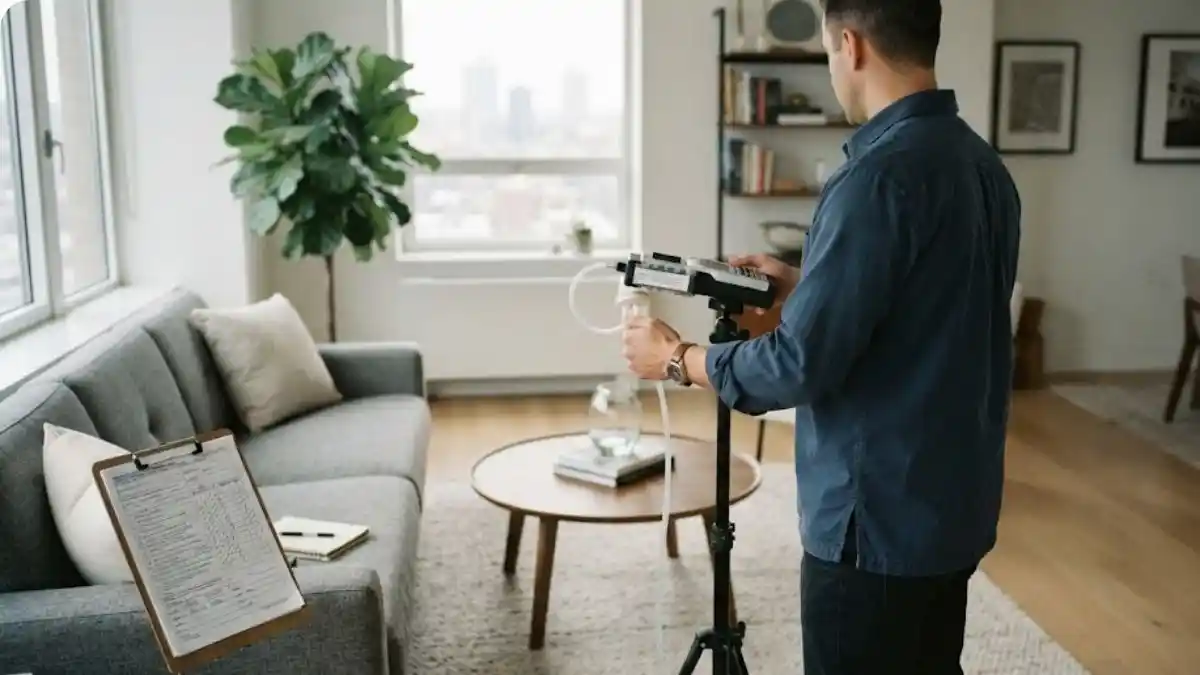
Mold Assessment & Sampling
Mold testing serves two distinct purposes: pre-remediation testing establishes whether mold is present, what species are involved, and where the contamination extends; post-remediation clearance testing confirms that remediation was successful and the space is safe for re-occupancy. Both purposes require sampling performed by someone independent from the contractor who will perform or did perform the remediation - a conflict of interest exists when the same party tests and remediates. We coordinate mold inspection and testing services and can advise on what sampling approaches are appropriate for your situation. Call (571) 741-6292 for mold inspection and testing coordination in Fairfax VA, Fairfax County, and Northern Virginia.
Air Sampling - The Standard Mold Testing Method
Air sampling for mold uses a calibrated pump that draws a measured air volume through a collection cassette over a set time period. The cassette is analyzed at a laboratory and the report identifies the genera and species of spores present and their concentration in spores per cubic meter of air. An outdoor control sample collected at the same time establishes the baseline spore types and levels naturally present in the area - the indoor sample is interpreted relative to the outdoor control.
The clearance standard for post-remediation air sampling is that indoor spore concentrations are not elevated above outdoor baseline for the same species. Elevated indoor levels of a species found outdoors suggests the remediation did not adequately contain or remove the mold. Elevated levels of species not found outdoors suggests contamination from a source that is not typical outdoor background. Call (571) 741-6292 to discuss air sampling for your commercial or condo property.
Surface Sampling - When Air Sampling Is Not Enough
Surface sampling using tape lifts or swabs is used when visible mold is present and identification of species is needed, when a specific surface is suspected as a contamination source, or when post-remediation verification of surface cleanliness is required at specific locations. Surface samples identify what is on a specific surface at the time of sampling; they do not characterize the overall air quality in the space the way air sampling does. The two methods are complementary: air sampling characterizes the space; surface sampling characterizes specific suspect materials. Call (571) 741-6292.
HVAC Mold Assessment
HVAC mold assessment in commercial buildings examines the components most likely to harbor or distribute mold: air handler coils and drain pans, supply and return plenums, flexible duct connector sections, and register boots. Visual inspection identifies visible growth. Swab samples of coil fins, drain pan surfaces, and duct lining near the air handler establish what species are present. For large commercial systems serving multiple floors in Tysons or Merrifield office buildings, HVAC assessment is a prerequisite for defining the full remediation scope - a mold colony on an air handler coil that has been distributing spores for months may require a broader remediation than the visible source location alone suggests. See our blog post Mold After Water Damage in a Fairfax Office Building for a property manager perspective. Call (571) 741-6292.
Post-Remediation Clearance Testing
Clearance testing after mold remediation is the quality-control step that confirms remediation was successful. Containment is removed, the space is allowed to equilibrate for at least an hour, and air samples are collected inside the remediated area along with a simultaneous outdoor control. Laboratory analysis compares indoor and outdoor spore profiles. If the clearance test passes, the space can be reconstructed and re-occupied. If elevated levels remain, the remediation contractor is notified and additional remediation is required before re-sampling.
For commercial buildings, clearance testing is essentially required for any mold remediation that will be the subject of an insurance claim or a tenant dispute. For condo units where the mold is part of a unit-above water damage event, clearance testing documentation protects both the remediating party and the unit owner. For pre-sale mold remediation, clearance testing provides the documentation a buyer's inspector will look for. Call (571) 741-6292 to schedule post-remediation clearance testing for your Fairfax County property.
When to Hire a Separate Inspector vs. the Same Company
The question of whether to use a separate inspector or the same company for testing and remediation has a straightforward answer for commercial and high-stakes situations: use a separate inspector. The reason is conflict of interest - a company that profits from finding mold and performing remediation has an incentive to identify more mold than is actually present, and a company that profits from remediation has an incentive to pass its own clearance testing. For insurance claims, tenant disputes, property sales, and any situation where the testing results will be used in a formal process, an independent inspector provides the most defensible documentation. For low-stakes situations - a homeowner who simply wants to know if a musty smell is mold - the same-company approach is reasonable for preliminary assessment. We are transparent about this distinction because it is the right advice. Call (571) 741-6292 and we will help you determine what level of independence your situation requires.
| Situation | Recommended Approach | Why |
|---|---|---|
| Insurance claim for mold damage | Independent inspector for both pre- and post-remediation testing | Insurer requires defensible, conflict-free documentation |
| Commercial tenant mold dispute | Independent inspector; results usable in legal process | Tenant or attorney will challenge testing done by remediation contractor |
| Pre-sale mold remediation | Independent inspector for clearance testing | Buyer's inspector will scrutinize; independent clearance is more credible |
| Routine post-water-event assessment | Same company acceptable for initial moisture and visual assessment | Lower stakes; if mold is found, move to independent testing before remediating |
| Suspected hidden mold, no prior event | Independent inspector first | Avoid unnecessary remediation scope driven by contractor interest |
Mold Testing FAQ
-
The lab report identifies mold genera and species found in the sample and their concentrations in spores per cubic meter. Compared to the outdoor control sample collected at the same time, it tells you whether your indoor levels are elevated above what is naturally present outside - the key indicator that mold is growing inside your building. The report also identifies species that are unusual or are strongly associated with water-damaged building materials (Stachybotrys, Chaetomium) even at lower concentrations. It does not tell you exactly where the mold is growing - that requires investigation. Call (571) 741-6292 to discuss your air sampling results or to coordinate testing for your property.
-
Clearance testing should be performed by an independent mold inspector - not the remediation contractor. After remediation is complete and containment is removed, schedule the inspector for air sampling inside the remediated space and an outdoor control. The inspector submits the cassettes to an accredited lab and provides a written report. If the report shows levels within acceptable range of the outdoor baseline, the space is cleared. If not, the remediation contractor is notified for additional work before re-sampling. Call (571) 741-6292 and we will advise on finding an independent inspector for your clearance testing in Fairfax County.
-
Most property management companies requiring a pre-repair mold inspection want air sampling results showing elevated levels above outdoor baseline (confirming the mold problem) and a written scope from a qualified inspector defining what remediation is needed. Some also require the inspector to specify clearance testing criteria. This documentation then supports the HOA authorization process and the insurance claim. We can coordinate the mold inspection and work with the inspector's scope to define our remediation approach. Call (571) 741-6292 to begin the coordination process for your Fairfax County property.