
Claims & Documentation
Water damage insurance claims in Fairfax County's commercial and condo markets involve more than one policy, more than one party, and documentation standards that most property owners encounter for the first time at the worst possible moment. We work with commercial property insurers, HOA master policy carriers, and HO-6 condo insurers across the Northern Virginia market - and we build the documentation package that adjusters need while the drying equipment is running, not after the restoration is complete. Call (571) 741-6292.
The Three Policy Types in Fairfax Condo and Commercial Claims
| Policy Type | Who Holds It | What It Typically Covers | What It Does Not Cover |
|---|---|---|---|
| Commercial property policy | Building owner / commercial landlord | Building structure, tenant improvement buildout (if covered), loss of rental income, business-interruption for owner-occupied space | Tenant personal property; tenant business interruption (covered under tenant's own policy) |
| HOA master policy | Condo association / HOA | Common elements (roof, exterior walls, shared plumbing, hallways, lobbies), often the building structure to "bare walls" or "original fixtures" | Interior finishes, upgrades above original specification, personal property - these fall to HO-6 |
| HO-6 (condo owner policy) | Individual condo unit owner | "Walls-in" - interior finishes, appliances, personal property, loss of use if unit uninhabitable | Common elements (covered by master policy); damage originating from a neighbor's unit may be subject to subrogation against neighbor's HO-6 |
The boundaries between these policies are defined by your governing documents - the declaration, bylaws, and any loss assessment provisions - not by a standard industry rule. "Walls-in" coverage sounds clear but often becomes contentious over items like in-wall plumbing pipes, HVAC equipment shared between units, and original-spec versus upgraded finishes. The practical guidance: file your own claim with your own carrier immediately, let them determine subrogation rights, and do not wait for inter-party disputes to be resolved before starting restoration. Water damage that sits gets exponentially more expensive for every party involved.
Commercial Property Claims - What Adjusters Require
A commercial water damage claim - whether the trigger is a sprinkler discharge, a pipe burst above a suspended ceiling, or a storm flood through a loading dock - requires documentation that goes significantly beyond a residential claim. Commercial adjusters reviewing large-loss claims look for:
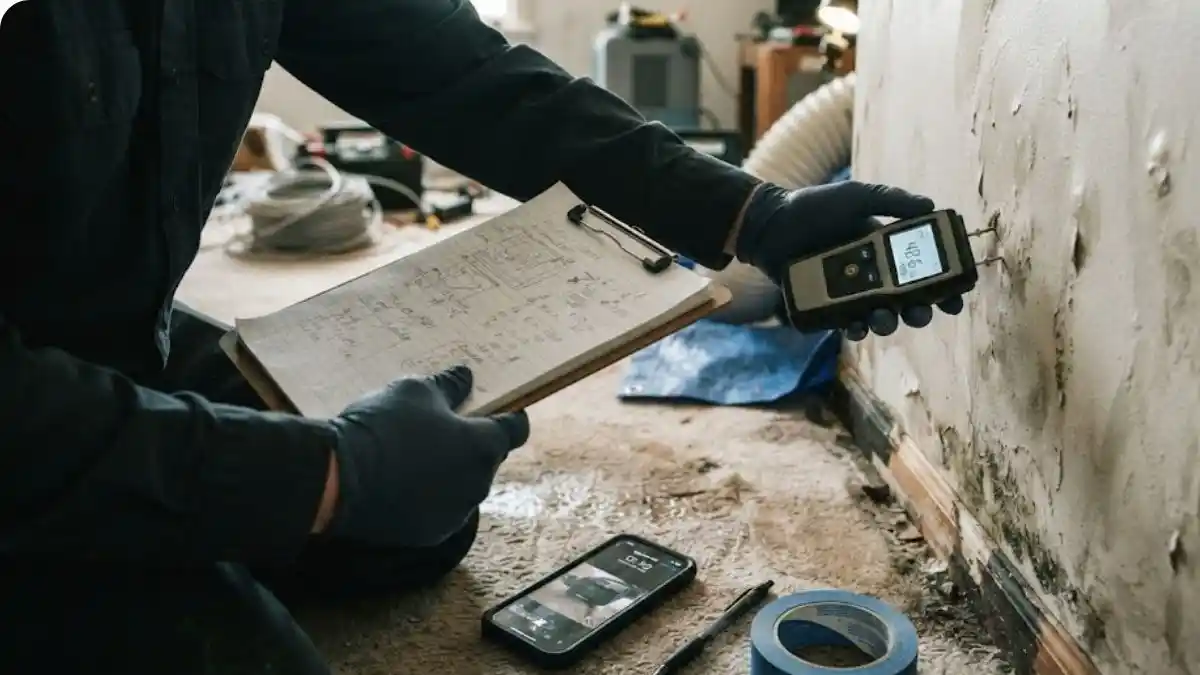
- Daily moisture logs with equipment serial numbers, placement diagrams, and psychrometric readings (temperature, relative humidity, dew point, grains per pound) for each drying zone
- Thermal imaging reports showing pre- and post-drying moisture profiles in structural assemblies
- Scope of work in Xactimate - the industry-standard estimating platform - with line-item pricing tied to IICRC S500 drying standards
- Photo documentation with timestamps covering source confirmation, initial damage extent, demolition decisions, equipment setup, and drying completion
- A timeline narrative connecting each scope decision (material removal, equipment change, completion date) to the moisture data that drove it
We build this package as a standard part of every commercial job - not as an add-on service. The documentation exists because it is how we track drying progress; producing it in adjuster-ready format is a parallel process that adds no time to the restoration timeline. For multi-tenant buildings where multiple adjusters are reviewing different portions of the claim, we produce suite-specific documentation packages on request. Call (571) 741-6292 for commercial and large-loss situations.
HOA Master Policy Claims - Coordination with Property Management
HOA master policy claims for water damage in common areas or shared building systems require the HOA board and property manager to be involved from the outset. Most master policies require notice within 24 to 48 hours of the event. The property manager controls access to mechanical rooms, rooftop systems, and common areas. The association's insurance broker or risk manager may have a preferred contractor list or approval process for any scope that affects common elements.
We are familiar with these requirements across Fairfax County's HOA market - from the layered governance of Reston's Reston Association plus individual condo HOAs, to the Centreville and Springfield townhome communities, to the larger mixed-use HOAs in Tysons and Mosaic District. We bring current certificates of insurance and licensing documentation, coordinate contractor authorization directly with property management, and keep the HOA's adjuster informed throughout the claim. See also our HOA vs. Owner: Who Pays for Water Damage in a Fairfax County Condo? guide for an educational overview of the responsibility framework.
HO-6 Condo Claims - Unit-Above and Multi-Party Events
HO-6 claims for ceiling water damage from a unit above are among the most procedurally complex condo claims in practice, because the source of the damage is in a space you do not control, the responsible party may dispute the origin or timeline, and the documentation must be established before any repair work begins - or the claim record is incomplete. Our assessment at the time of initial response produces: dated photographs with moisture readings, apparent source location or notation that source confirmation is pending, and the full extent of your unit's saturation. That record is what your carrier, the upstairs owner's carrier, and the HOA will all reference.
For loss-assessment claims - where the HOA passes a portion of a large-loss claim back to unit owners via their HO-6 policies - the governing documents and master policy deductible amounts determine the split. We can assist with the physical damage documentation; the actual claim filing and loss-assessment dispute process involves your insurer and potentially a public adjuster or attorney. Our HOA vs. Owner Responsibility Checker provides an educational starting framework.
Business-Interruption Claims for Commercial Tenants
Commercial tenants whose space is rendered unusable by water damage may have business-interruption (BI) coverage under their own commercial property policy. BI claims require documentation of the period of interruption, the revenue impact, and the restoration timeline. We assist with the physical restoration timeline documentation - scope of work, drying completion dates, reconstruction milestones - that supports the BI claim narrative. The financial impact calculation and actual BI claim filing is handled by your broker, accountant, or public adjuster. Use our Business Water Downtime Cost Calculator as a starting framework for internal impact estimation.
What We Do Not Provide
For the physical documentation side, call (571) 741-6292 at any stage of your claim.
We are a restoration contractor, not an insurance adjuster, public adjuster, or attorney. We do not negotiate claim settlements, provide coverage opinions, or represent you in a dispute with your carrier. We produce the physical documentation - moisture data, scope, photographs, timeline - that any of those parties will need to do their jobs. For coverage disputes, contact your insurance broker. For claim disputes, a licensed public adjuster or attorney familiar with Virginia insurance law is the appropriate resource.
Insurance Claims FAQ
-
Call us first for emergency extraction - every hour of delay increases the extent of saturation and the eventual claim cost. You can notify your insurer in parallel while extraction is underway. Calling your insurer first and waiting for an adjuster to authorize work before starting drying is one of the most common and costly mistakes in commercial and condo water damage situations. Adjusters review damage after the fact; they do not authorize drying timelines in real time. Call (571) 741-6292 to start extraction immediately, then notify your carrier.
-
Yes. Commercial adjusters reviewing large-loss claims expect Xactimate-format line-item pricing. We produce scope in that format as a standard part of our commercial documentation. Residential HO-6 claims may use Xactimate or similar tools depending on the carrier. If your adjuster uses a specific format or has a preferred documentation structure, let us know at the outset and we will align our reporting to it.
-
Subrogation is the process by which your insurer pays your claim and then seeks reimbursement from the responsible party's insurer. You file your HO-6 claim, your insurer pays your loss minus your deductible, and then your insurer's subrogation department pursues the upstairs owner's HO-6 carrier. Your role in that process is primarily to provide accurate information about the source and timeline, which is why our documentation at the time of assessment matters. You should not need to manage the insurer-to-insurer recovery process directly - your carrier handles that. What matters on your end is that the documentation is complete and unambiguous.
-
Large master policy deductibles are increasingly common in Fairfax County HOA communities. In some cases the deductible exceeds the cost of the damage, in which case the HOA self-insures the event. In others the HOA may assess the deductible cost back to unit owners via a "loss assessment" provision - which is typically covered under HO-6 policies up to a sub-limit. Review your HO-6 policy for loss assessment coverage language and your HOA's governing documents for the assessment procedure. Your insurer and the association's risk manager are the right resources for the coverage question. Call (571) 741-6292 for the physical restoration side.