
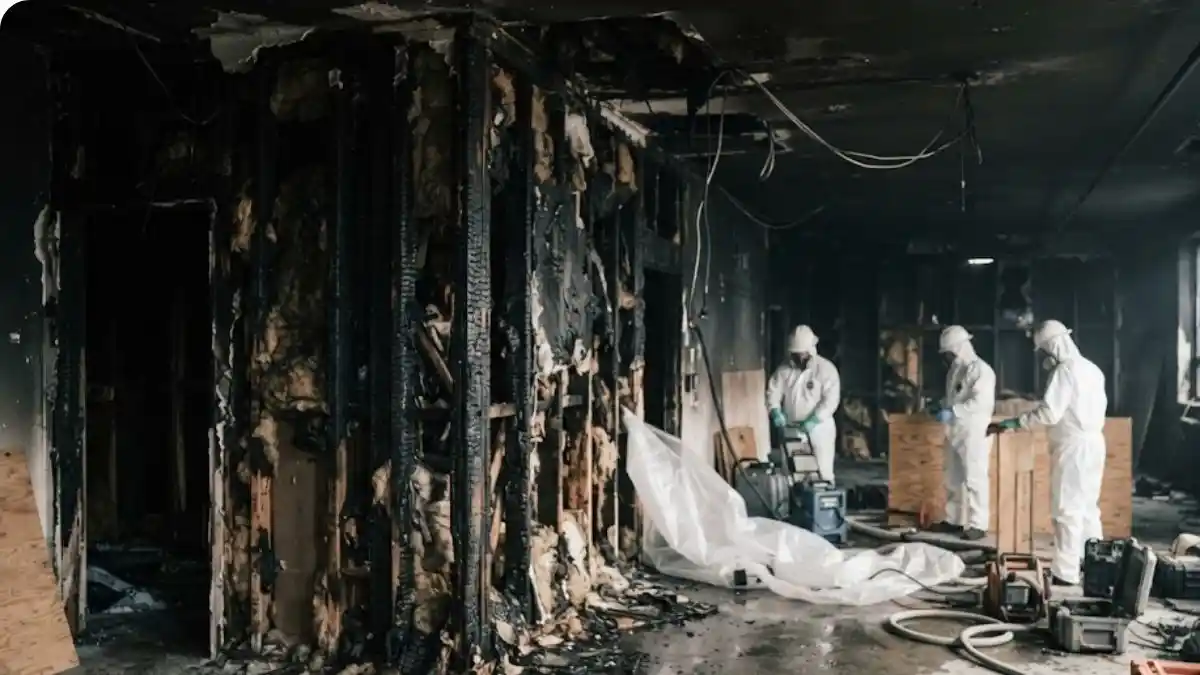
Fire & Smoke Restoration
Fire damage restoration in a commercial building or multi-unit condo involves more damage types, more parties, and more regulatory steps than any other restoration scenario. The fire itself causes char, structural damage, and contents loss. The firefighting water - typically several thousand gallons across a working structure fire - causes water damage that in many cases exceeds the direct fire damage in scope. The smoke and soot distribute through HVAC systems and wall penetrations into spaces with no visible fire contact. And the building cannot be re-entered for restoration work until the fire marshal authorizes access. Call (571) 741-6292 for fire damage situations in Fairfax VA, Fairfax County, and Northern Virginia.
Immediate Post-Fire Steps - Before Restoration Begins
The sequence of events after a fire is governed by the fire marshal and the property's insurer, not by the restoration contractor. The fire marshal must authorize re-entry before any work begins. The insurer typically requires notification and may want to send their own adjuster before significant demolition. Within those constraints, the first restoration actions are emergency board-up and tarping to secure structural openings, and emergency extraction of firefighting water to prevent secondary mold growth.
We coordinate entry timing with the fire marshal's office and work within the property's insurance authorization process. Do not allow anyone - including other contractors - to begin demolition or cleaning until fire marshal clearance is confirmed in writing. Call (571) 741-6292 to begin the coordination process as soon as your insurer is notified.
Fire Types and Their Restoration Implications
Kitchen Fire - Residential and Commercial
Kitchen fires are the most common fire event in both residential condos and commercial food-service tenants in Fairfax County's mixed-use buildings. Grease fires produce wet soot - a sticky, tar-like residue that adheres strongly to surfaces and is extremely difficult to remove without professional chemical cleaning agents. A grease fire that activates the kitchen's suppression system (Ansul or similar wet chemical system) adds a layer of suppressant chemical to the grease soot - a combination that stains permanently if not removed within 24 to 48 hours. See Smoke & Soot Cleanup for the specific cleaning protocol. Call (571) 741-6292 immediately after a kitchen fire.
Electrical Fire - Panel Room and In-Wall Events
Electrical fires in panel rooms, wall cavities, and attic spaces produce dry soot - fine, powdery residue that spreads through HVAC systems across large areas before any visible flame damage is present. A smoldering electrical fire in a wall cavity may produce smoke that migrates through the wall assembly and appears in multiple rooms before any visible damage is evident. The scope of soot spread is typically larger than the scope of structural fire damage. HVAC shutdown is the first priority for limiting spread; see Smoke & Soot First-Steps Checklist for immediate actions. Call (571) 741-6292.
Chimney Fire - Older Residential and Condo Buildings
Chimney fires in Fairfax County's 1960s and 1970s residential and condo buildings - many of which have masonry chimneys with aging flue liners - can spread to adjacent structural framing through cracks in the flue lining or at the chimney-wall interface. The damage is often not immediately visible; thermal imaging of the chimney chase and adjacent wall assemblies is the starting assessment step. Chimney fires also produce significant creosote soot that requires specialized cleaning. Entry authorization depends on structural integrity confirmation by a licensed engineer or inspector. Call (571) 741-6292.
Firefighting Water - A Water Damage Event Inside the Fire Restoration
Structure fire suppression uses thousands of gallons of water - a working fire in a commercial space can receive 500 to 2,000 gallons per minute from fire department hoselines. That water soaks structural assemblies, flows into below-grade spaces, and creates a secondary water damage scope that must be addressed in parallel with the fire and smoke restoration. The water from firefighting operations is always Category 3 - it has contacted fire-damaged, soot-coated surfaces and may carry ash, chemical suppressants, and structural debris in suspension.
Firefighting water extraction must begin as soon as fire marshal authorization permits re-entry, because the water damage timeline (48 to 72 hours to mold growth in uncontrolled conditions) runs independently of the fire restoration timeline. We sequence firefighting water extraction as the first physical work after board-up, before soot cleaning, before demolition scope is finalized. Call (571) 741-6292 for any fire event involving significant firefighting water.
Neighboring-Unit Fire Damage in Multi-Unit Buildings
One of the most disorienting situations for Fairfax County condo and apartment building residents is damage from a fire that originated in a neighboring unit. Your unit has no visible char, but smoke has migrated through shared wall penetrations, HVAC connections, and the building's common corridors. Your belongings smell of smoke. Your ceiling may have water damage from firefighting operations above. And your access to your unit may be restricted by the fire marshal's order until the structural integrity of the building is confirmed.
For occupants of units adjacent to or below the fire unit, the restoration scope typically includes: smoke and soot assessment and cleaning of all surfaces that received smoke migration, firefighting water extraction and drying if water entered from above or through shared assemblies, contents assessment (some contents can be cleaned; others require replacement), and documentation for your HO-6 claim. The fire originated in a neighboring unit, so your claim runs against your own HO-6 policy with potential subrogation against the fire-unit owner's liability. See Insurance Claims Support and our blog post Fire Damage Restoration in Fairfax: What Happens to the Rest of the Building? Call (571) 741-6292.
Emergency Board-Up After Fire
Any structural opening created by the fire - window frames, door frames, roof sections - must be secured before the building can be left unattended. Emergency board-up prevents additional weather damage, unauthorized access, and animal intrusion while the building is in the restoration process. We provide board-up as a parallel service to extraction and assessment, using fire-rated materials where required by the fire marshal. See Emergency Board-Up for detail on the board-up process for commercial and multi-unit buildings.
Contents Pack-Out and Restoration
Commercial contents - office equipment, furniture, inventory, documents, electronics - and residential contents damaged by fire, smoke, and firefighting water are assessed at the time of initial walkthrough. Items that can be professionally cleaned and restored are packed out to our facility for cleaning; items that cannot be restored are documented for the insurance claim. Electronic equipment that has been exposed to smoke and heat requires professional assessment before any power is applied - residual soot inside electronics causes short circuits when power is restored. See Contents Cleaning & Restoration for the full pack-out and cleaning process. Call (571) 741-6292.
Fire Damage Restoration FAQ
-
Not until the fire marshal authorizes re-entry. This is non-negotiable regardless of urgency. The fire marshal must confirm there are no hot spots, structural collapse risk, or hazardous materials concerns before any workers can enter. Once clearance is given, we can begin board-up and extraction simultaneously. Emergency extraction of firefighting water should start within hours of clearance - the water damage clock is running. Call (571) 741-6292 as soon as you know clearance is being authorized so we can have crew and equipment staged.
-
Smoke damage to your unit from a neighboring fire is typically covered by your HO-6 policy as an event that was sudden and not caused by your negligence. Your insurer may pursue subrogation against the fire-origin unit's liability coverage. The documentation for a smoke-only claim includes photographs of all smoke-affected surfaces, air quality readings if available, and a scope of cleaning and contents that is separate from the fire-origin unit's scope. We produce per-unit documentation that serves your claim independently. Call (571) 741-6292.
-
It depends on the degree of char penetration and structural integrity. Surface char on framing lumber that has not lost structural section can be cleaned and encapsulated rather than replaced. Deep char that has penetrated to the structural core of the member requires replacement. Our structural assessment post-fire uses a combination of visual inspection and probing to determine which framing members retain structural capacity. We make material-by-material decisions based on the actual condition, not a default gut-everything protocol - selective demolition and restoration reduces reconstruction cost and time where the structure permits it. Call (571) 741-6292.