
Mold Remediation & Clearance
Mold remediation in a commercial building or multi-unit condo is a different undertaking than residential mold cleanup. The HVAC systems that serve commercial and multi-unit buildings are connected across large areas - a mold colony on a return-air plenum surface can distribute spores to every space in the air-handler zone before the colony is visible. Tenant liability exposure in Virginia for landlords who allow mold to remain in a rental property creates urgency that goes beyond the health concern alone. And the documentation standard for post-remediation verification in a commercial claim is more rigorous than in a typical residential job. Call (571) 741-6292 for mold remediation in Fairfax VA, Fairfax County, and Northern Virginia.
The Mold Remediation Protocol
Containment Establishment
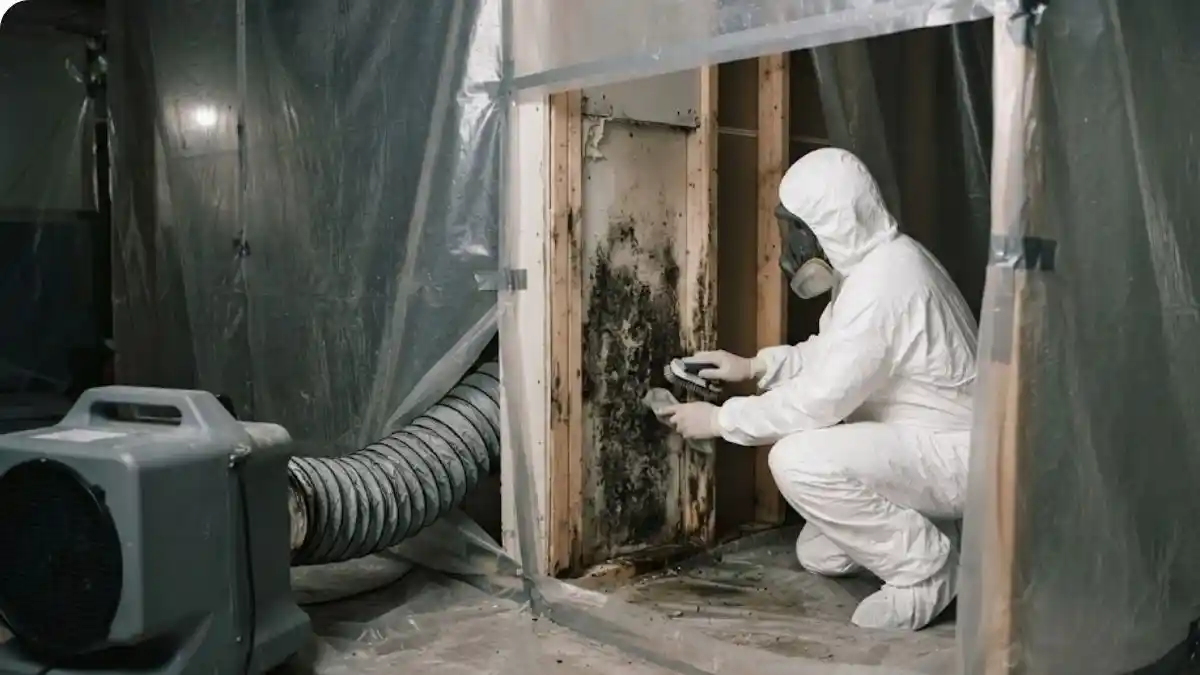
Before any mold-affected material is disturbed, physical containment is established around the work zone using polyethylene sheeting sealed to wall, floor, and ceiling surfaces with tape. The purpose of containment is to prevent spore dispersal to adjacent spaces during demolition: cutting, removing, or brushing mold-affected drywall releases millions of spores into the air. Without containment, those spores deposit on surfaces throughout the building. In commercial buildings with shared HVAC, the supply and return registers within the containment zone are sealed before work begins. Call (571) 741-6292 for mold situations in Fairfax County commercial and condo buildings.
Negative-Air Pressure and HEPA Filtration
Negative-air machines equipped with HEPA filters are run inside the containment zone to maintain air pressure inside the containment below the pressure in adjacent areas. This negative pressure differential means that any air movement at containment boundaries flows inward - from the clean area into the containment - rather than outward, preventing spore-laden air from escaping into the building. HEPA filters capture particles down to 0.3 microns at 99.97% efficiency; mold spores range from 1 to 100 microns, well within HEPA capture range. The negative-air machine exhausts HEPA-filtered air outside the containment zone, either through a duct to building exterior or through a series of HEPA units in cascade. Call (571) 741-6292.
Affected Material Removal
Mold-affected porous materials - drywall, insulation, carpet, wood that has sustained deep mold penetration - are removed inside the containment zone. Material is placed in sealed poly bags before being moved through any uncontaminated area. The framing and structural materials behind removed drywall are assessed: surface mold on wood framing can often be addressed by HEPA vacuuming, wire brushing, and antimicrobial treatment without structural replacement. Deep mold penetration into the wood grain requires material replacement. The scope decision is made at the time of removal based on actual conditions. Call (571) 741-6292.
HEPA Vacuuming and Surface Cleaning
After affected materials are removed, exposed structural surfaces are HEPA vacuumed to remove loose spores and debris, then cleaned with an antimicrobial agent applied at appropriate concentration and contact time. A second antimicrobial application follows the surface cleaning. All surfaces within the containment zone - not just visibly mold-affected surfaces - receive antimicrobial treatment to address spore deposition that occurred during the work. Call (571) 741-6292.
Post-Remediation Verification and Clearance Testing
Post-remediation clearance testing - air sampling and/or surface sampling performed by an independent inspector after remediation is complete and containment is removed - confirms that the mold problem has been adequately addressed. The clearance standard is that airborne spore levels inside the remediated space are not elevated above outdoor baseline levels for the same species. We recommend independent clearance testing for all commercial and multi-unit mold remediation projects; for residential jobs, we advise it strongly when the event will be the subject of an insurance claim or a property transaction. See Mold Inspection & Testing for the clearance testing process and consider scheduling your independent inspector before remediation begins. Call (571) 741-6292.
Mold Scenarios by Type
Black Mold (Stachybotrys)
Stachybotrys chartarum - commonly called "black mold" - requires sustained high moisture levels to establish, typically greater than 90% relative humidity at the material surface for extended periods. It is most commonly found on paper-faced drywall, ceiling tiles, and wood in chronically wet conditions: slow-leak areas, crawlspaces without vapor barriers, and materials that were not dried after a water event. The remediation protocol for Stachybotrys is the same as for other mold species: HEPA containment, negative air, affected material removal, surface cleaning, and clearance testing. The media coverage of "toxic black mold" creates significant anxiety, but the remediation protocol does not differ from other species - the containment and negative-air requirements that apply to all mold remediation projects are what matters. Call (571) 741-6292.
Hidden Mold in Wall Cavities
Mold inside wall cavities - behind drywall, in insulation, on structural framing - is often not visible on the surface and is identified by persistent musty odor, occupant health symptoms, or investigation following a known water event. Hidden mold assessment requires either intrusive investigation (opening wall sections) or air sampling that shows elevated spore counts without visible surface mold. The remediation scope for hidden mold is essentially the same as visible mold once the material is accessed: the containment, negative air, and material removal sequence applies regardless of whether the mold was visible before demolition began. Call (571) 741-6292.
HVAC Mold in Commercial Buildings
Mold on HVAC components - air handler coils, drain pans, duct lining, and supply/return registers - distributes spores throughout the air-handler zone on every system cycle. HVAC mold remediation requires isolating the affected components, cleaning accessible surfaces (coils, drain pans, plenums), and in cases where duct lining has been colonized, either encapsulation or section replacement. Full duct cleaning by a certified contractor is typically required after HVAC mold remediation to remove settled spores from duct surfaces that cleaning at the air handler cannot reach. This is a common scope in Fairfax County's commercial buildings after water events that were not fully dried. See our blog post Mold After Water Damage in a Fairfax Office Building: What Property Managers Need to Know. Call (571) 741-6292.
Post-Water-Event Mold Prevention
Mold after a water damage event is not inevitable - it is the consequence of insufficient or delayed drying. When water events are addressed with proper extraction and structural drying within the 48-to-72-hour window, mold does not establish. When drying is delayed, incomplete, or self-performed without moisture verification, mold growth in hidden spaces is nearly certain. If you have had a recent water event and are concerned about hidden mold, or if a prior water event was not professionally dried, call (571) 741-6292 for an assessment. For properties with a known prior water event and a planned sale or tenant transition, pre-assessment before listing is advisable.
Mold Remediation FAQ
-
Testing before remediation provides the most defensible documentation and helps define the scope precisely - we recommend it, particularly for insurance claims and commercial jobs. However, if you have visible mold growth covering more than a small area (roughly 10 square feet), the remediation scope is clear and pre-testing may not change it significantly. For hidden mold suspected but not confirmed, pre-testing by an independent inspector establishes whether remediation is needed and where. See Mold Inspection & Testing for the testing process. Call (571) 741-6292 and we will advise based on your specific situation.
-
In different zones of the same building, yes. The containment boundaries for mold remediation must be maintained separately from the drying zones for active water damage. If mold is present in one area and active drying is underway in an adjacent area, we establish the containment boundary between the zones and run both operations simultaneously where the floorplate permits. The mold remediation scope and the water damage drying scope are documented separately for the insurance claim. Call (571) 741-6292 to discuss your specific building layout.
-
Virginia law requires landlords to maintain rental property in a habitable condition; persistent mold that affects habitability creates a potential basis for tenants to withhold rent or terminate their lease. The specific legal obligations depend on the lease terms and the facts of the situation - we are not attorneys and cannot provide legal advice. What we can provide is the physical documentation that any legal process will require: moisture assessment, mold identification, remediation scope and completion documentation, and post-remediation clearance testing. Addressing the mold promptly and documenting the response is the practical first step regardless of the legal dimension. Call (571) 741-6292 for commercial mold assessment and remediation in Fairfax County.