
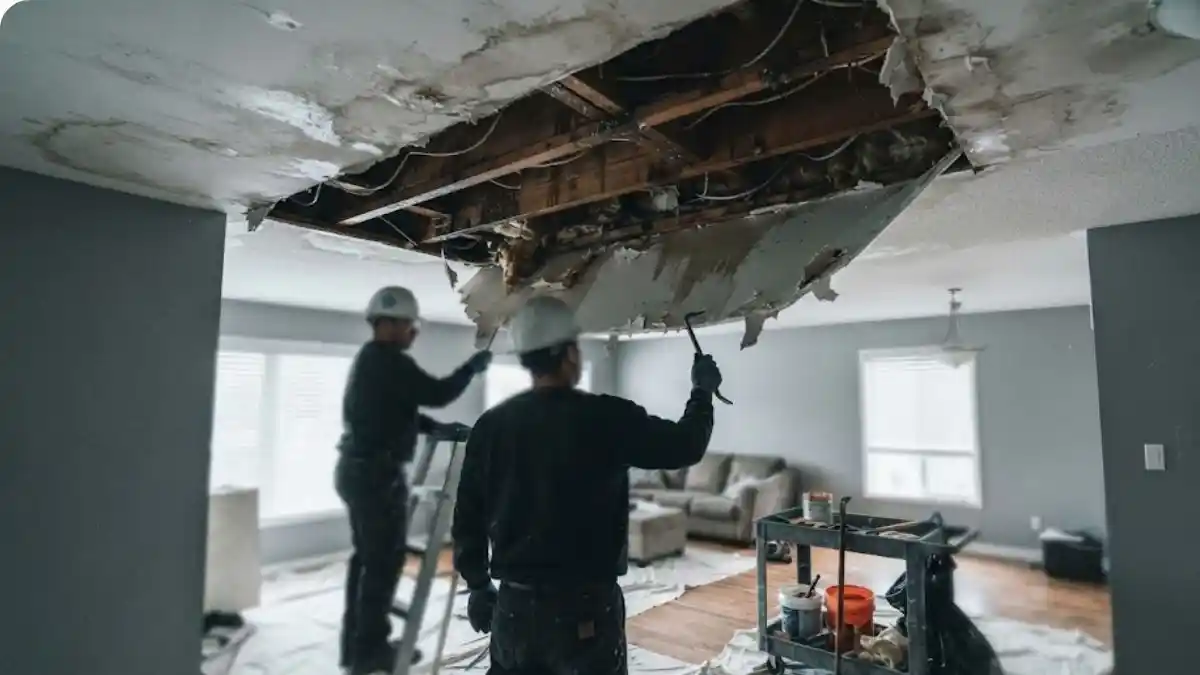
Pipe Failure & Freeze Events
Burst and frozen pipe events in Fairfax County happen across two distinct seasons: winter freeze events that split pipes in unheated or under-insulated spaces, and year-round supply-line failures driven by aging plumbing infrastructure across the county's housing stock. Both produce Category 1 water that must be extracted and dried quickly before the 48-to-72-hour mold window closes. In multi-unit buildings and condos, the water spreads laterally and vertically through shared assemblies faster than in detached housing - one pipe failure can affect multiple units before the shutoff is located. Call (571) 741-6292 for burst and frozen pipe situations across Fairfax VA, Fairfax County, and Northern Virginia.
Supply-Line Failures - The Plumbing Behind Your Walls
Supply-line failures are the most common pipe-related water damage event in Fairfax County residential and condo buildings. The failure points differ by plumbing era:
| Plumbing Type | Common In | Failure Mode | Risk Level |
|---|---|---|---|
| Polybutylene (PB) | 1980s–mid-1990s construction (Springfield, Centreville, Reston townhomes) | Chlorine degradation causes brittleness; sudden failure at fittings with no visible warning | High - affected systems should be professionally evaluated |
| Galvanized steel | 1960s–1970s garden condos (Annandale, Fairfax Circle, older Reston phases) | Internal corrosion reduces pipe wall thickness; pinhole leaks progress to full failures | Moderate-high in aging stock |
| Copper | 1970s–present (most Fairfax County residential) | Pinhole corrosion (aggressive water chemistry), mechanical failure at soldered fittings | Low in good condition; higher where original 1970s copper has never been replaced |
| CPVC / PEX | 1990s–present | PEX fittings can fail under freezing conditions; CPVC brittle in cold exposure | Low in typical conditions; moderate in unheated spaces |
| Braided supply hoses | All eras - toilet, washing machine, dishwasher connections | Stainless braid fatigue failure at end fittings; plastic fittings crack under water pressure | Moderate - high-volume failure when it occurs |
Supply-line failures in wall cavities and under-floor spaces often run for hours before discovery - while the building is occupied, the sound of running water is masked by HVAC and daily activity; overnight or during vacancy, the failure may run until morning. The volume deposited can be substantial: a 3/8-inch supply line at typical residential pressure releases approximately 3 gallons per minute. Eight hours undetected equals nearly 1,500 gallons. Call (571) 741-6292 as soon as the failure is discovered - every additional hour increases scope.
Frozen Pipe Events - Fairfax County Winters
Fairfax County's winters average several episodes of overnight temperatures below 20°F per season, with occasional extended cold snaps below 10°F. Pipes freeze when the ambient temperature around them drops below 32°F for a sustained period - typically pipes in exterior walls, unheated crawlspaces, and uninsulated garage spaces. The freeze itself does not cause immediate water release; the damage occurs when the ice melts and the split pipe section, which has lost structural integrity, cannot contain water pressure. This means the damage may not present until temperatures rise - sometimes hours or days after the freeze event.
In Fairfax County condos and townhome communities, the most vulnerable pipe locations are: supply lines running through exterior walls in units on the building perimeter (particularly end units with two exterior wall exposures), pipes in utility closets on exterior walls without interior heat access, and hose bibs that were not winterized before the freeze. In commercial buildings, pipes in unheated storage areas, stairwells, and loading dock areas are the primary risk locations. Call (571) 741-6292 if you discover frozen pipe damage as temperatures warm.
Slab-Leak Water Spread - Damage Scope Only
A slab leak - a supply or drain pipe failure beneath the concrete slab foundation - is a plumbing repair that must be performed by a licensed plumber. Our scope is the water damage that results from a slab leak: moisture that has migrated up through the slab, saturated the flooring system above, and spread into adjacent wall cavities and flooring areas. We do not perform slab penetration or pipe repair.
Slab leaks produce a distinctive damage pattern: the water appears at the floor surface - often as damp spots, warping in hardwood or engineered wood flooring, or lifting of tile - without a visible overhead source. The saturation is concentrated at the floor level and spreads outward and upward through wall framing. Drying a slab-leak event requires specialized floor-drying equipment (drying mats for hardwood, dehumidification below grade where accessible) and patience - concrete slabs are slow to dry and cannot be verified at target moisture content without deep-probe readings. Hardwood flooring that has been wet for more than 24 to 48 hours may cup or buckle before it can be dried, and may require replacement regardless of drying effort. Call (571) 741-6292 once your plumber has confirmed the pipe is repaired.
Unattended-Property and Vacancy Damage
Pipe failures in unoccupied properties - whether a condo unit left vacant during travel, a commercial space between tenants, or a property in an estate - produce the most extensive water damage per event because they run without detection until the water becomes visible to a neighbor, building manager, or returning occupant. A 24-hour undetected failure in a multi-unit building can saturate multiple units across several floors.
Vacancy damage creates two specific documentation challenges: establishing the failure timeline (when did the pipe fail, not when was it discovered) and distinguishing between pre-existing conditions and damage caused by the current event. Both matter for the insurance claim. We document the state of the property at the time of initial assessment - moisture levels, visible damage, water staining and tide lines - and note any pre-existing conditions that are distinguishable from the current event. See our blog post Burst Pipe in a Fairfax Condo During Winter Travel: What to Expect When You Return for a walkthrough of the discovery and remediation sequence. Call (571) 741-6292 for vacancy damage situations.
Multi-Unit Building Pipe Failures
In Fairfax County condos and multi-unit buildings, a single pipe failure in one unit commonly affects the units below and potentially adjacent units through shared wall assemblies. The affected unit owner needs to coordinate with the building's property manager for common-area access and contractor authorization; the units below need separate scope documentation for their own insurance claims; and the property manager needs to notify the HOA and potentially the association's insurer if common elements are affected. We carry the contractor authorization documentation commercial property managers require and produce per-unit scope packages where multiple units are affected. See Ceiling & Unit-Above Water Damage for the receiving-unit perspective, and Insurance Claims Support for multi-party claim documentation. Call (571) 741-6292.
Pipe Failure FAQ
-
Call both simultaneously if possible - or call us first if water is still actively flowing. The pipe repair and the water damage remediation are separate scopes that can run concurrently: the plumber locates and repairs the break while we begin extraction in the affected areas. Waiting for the plumber to finish before calling for extraction delays the drying process unnecessarily. If you cannot reach a plumber immediately, shut the main water supply valve to the unit or building to stop the flow, then call (571) 741-6292.
-
If pipes are frozen but have not yet burst, do not attempt to thaw them rapidly with open flame or high heat - the rapid pressure change can rupture the pipe at weak points. Gentle warming with a hair dryer, heat tape, or simply allowing the space to warm gradually is safer. Shut off the main water supply to the affected section before the thaw begins - if the pipe has already split at the freeze point (which you may not be able to confirm before thawing), having the water off prevents discharge when pressure is restored. Once the pipes have thawed and you have confirmed their integrity (or discovered a failure), call (571) 741-6292 for any water damage assessment.
-
Potentially yes, if the cupping is mild and drying begins quickly. Hardwood floors cup when the bottom face absorbs moisture faster than the top face - the differential expansion bows the board upward at the edges. If this moisture differential is corrected through drying before the boards exceed their elastic deformation limit, the cupping may reverse as the wood dries to equilibrium. Severe cupping, buckling, or cases where moisture content has been elevated for more than 48 to 72 hours have a lower recovery probability. We assess hardwood flooring moisture content (both above and below the floor where accessible) and make a drying-in-place versus replacement recommendation based on the actual readings, not a default protocol. Call (571) 741-6292.