
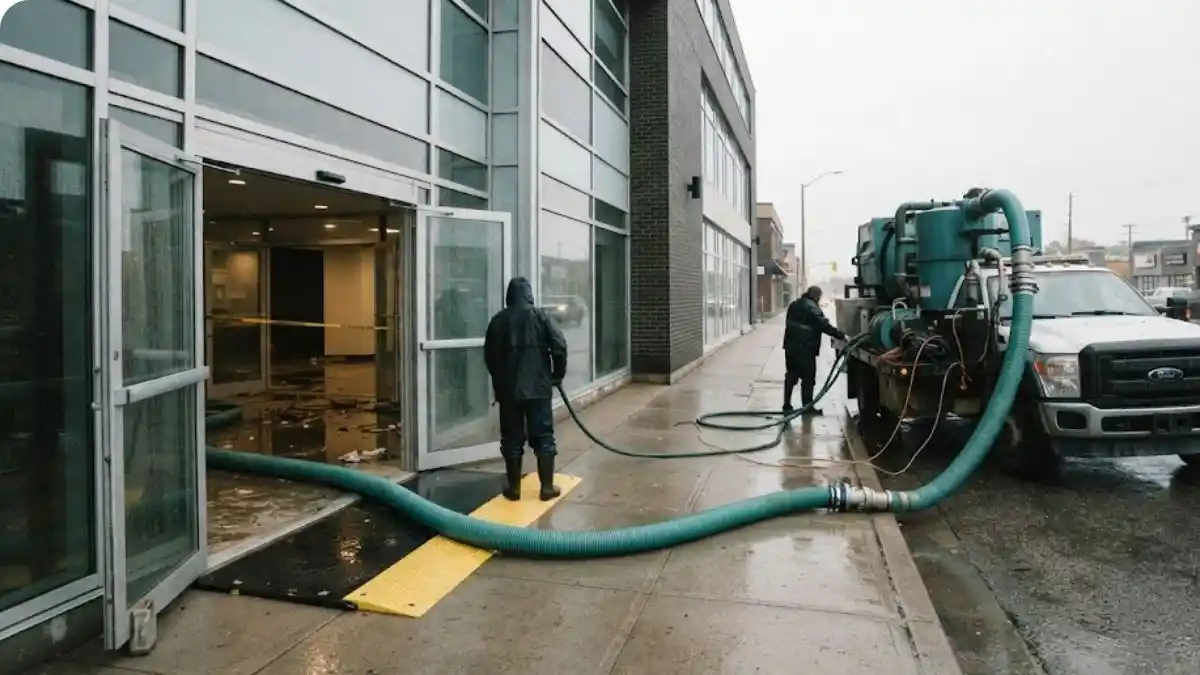
Water Extraction & Mitigation
Emergency water removal is the first and most time-critical phase of any water damage event. The speed and completeness of initial extraction determines how far water migrates into structural assemblies, how much selective demolition becomes necessary, and whether the 48-to-72-hour mold-growth window is beaten. For commercial properties, condominiums, and multi-unit buildings in Fairfax VA and Fairfax County, the extraction challenge is larger than a residential job - more floor area, more complex assemblies, multiple concurrent zones. Call (571) 741-6292 immediately for any water event in commercial or multi-unit property.
Extraction - Removing Standing Water
Standing water is removed with truck-mounted extraction units - the standard for commercial and large-area residential jobs. Truck-mounted extractors generate significantly higher vacuum and flow rates than portable units: a commercial truck-mount can remove 25 to 35 gallons of water per minute from an open floor, compared to 3 to 5 gallons per minute for a portable extractor. For a 5,000-square-foot commercial floor with 1 inch of standing water - approximately 3,100 gallons - a truck-mount can achieve primary extraction in under two hours; a portable unit would take most of a day and leave more residual moisture in the surface materials.
Carpet and pad extraction follows different protocols: wand extraction pulls water from the carpet face and backing, but the pad underneath absorbs and retains water at a rate that wand extraction cannot fully recover. Pad removal is almost always the correct decision for any significant water event - leaving a saturated pad in place under a dried carpet surface is one of the most common causes of post-restoration mold claims. Hardwood and engineered wood floors require a different assessment: depending on the species, finish, and degree of saturation, in-place drying with floor-drying mats and dehumidification may be possible; buckled or cupped flooring typically requires removal.
Moisture Mapping - Establishing the True Extent
Visible water is the smallest part of the problem. Water that enters a structure migrates by capillary action into drywall, insulation, framing lumber, concrete, and flooring assemblies - often well beyond the visibly wet area. Moisture mapping uses two primary tools: calibrated moisture meters (pin and non-invasive) that measure moisture content in structural materials at specific points, and infrared thermal cameras that reveal temperature differentials indicating moisture presence across large areas without material contact.
A thorough moisture map before any demolition decision identifies the full perimeter of saturation, distinguishes materials that can be dried in place from those that must be removed, and establishes the baseline against which drying progress is measured. For commercial floor plates with suspended ceilings, moisture mapping above the ceiling grid is essential - water deposited above ceiling tiles will not show on floor-level readings until it has saturated the tiles and begun dripping, by which point the above-ceiling materials have been wet for hours.
Water Categories - What the Source Determines
| Category | Source Examples | Health Concern | Material Handling Difference |
|---|---|---|---|
| Category 1 - Clean | Supply-line breaks, overflowing sinks (clean water), rain intrusion through intact roof, ice dam melt | Minimal at source; risk increases if left standing | Porous materials can often be dried in place if addressed quickly |
| Category 2 - Gray | Dishwasher overflow, washing machine discharge, toilet tank overflow (no bowl water), aquarium leak | May contain bacteria or chemical contaminants; not immediately hazardous but not safe for contact | Porous materials that cannot be dried within 24–48 hours should be removed; antimicrobial treatment of structure |
| Category 3 - Black | Sewage backup, toilet bowl overflow, rising groundwater (post-storm), firefighting water that has contacted contaminated surfaces | May contain pathogens, bacteria, viruses; biohazard handling protocols required | All porous materials that have absorbed Cat 3 water should be removed; specialist PPE; ATP surface testing post-cleaning |
Water category can change. Category 1 water that stands for more than 24 to 48 hours at warm temperatures degrades to Category 2 as microbial growth begins. Category 2 water contacting porous materials and allowed to stand can reach Category 3 conditions. This is one of the reasons speed of extraction matters beyond just the structural drying timeline - the longer water sits, the more expensive and invasive the remediation protocol becomes.
Structural Drying - The Multi-Phase Process
Once extraction is complete and the moisture map is established, structural drying begins. This is not simply placing fans and leaving - it is an engineered drying process governed by psychrometric principles and tracked daily against IICRC S500 drying standards.
Phase 1: Evaporation
High-velocity air movers positioned at a low angle to the affected surface create directed airflow that accelerates evaporation from the wet material surface. The correct ratio of air movers to dehumidifiers is determined by the cubic footage of the affected space, not by a fixed count. Insufficient air movers slow drying; insufficient dehumidifiers to remove the evaporated moisture from the air cause relative humidity to rise above the evaporation threshold and drying stops entirely.
Phase 2: Dehumidification
Commercial low-grain refrigerant (LGR) dehumidifiers remove moisture from the air continuously, maintaining conditions that keep the evaporation process active. LGR units operate efficiently at lower grain-per-pound levels than standard refrigerant dehumidifiers - relevant for the later stages of drying when the air moisture load is lower and standard units would cycle off prematurely. For large commercial floor plates, multiple LGR units running in targeted drying zones are standard. Desiccant dehumidifiers are used when ambient temperatures are very low (below 45°F) - relevant for unheated commercial spaces in Fairfax County winters.
Phase 3: Daily Monitoring and Documentation
Psychrometric readings - temperature, relative humidity, dew point, and grains per pound - are recorded at each monitoring location daily. Moisture meter readings in structural materials are logged and compared to the previous day's readings to confirm drying trajectory. Equipment adjustments (repositioning air movers, moving dehumidifiers, opening or closing drying zones) are made based on daily data. This daily log is also the documentation foundation for the insurance claim - see Water Damage Insurance Claims.
Phase 4: Verification and Equipment Removal
Drying is complete when structural materials reach target moisture content - typically below 16% for wood framing and below 1% for concrete, though the specific target depends on the material's pre-loss baseline and the IICRC S500 class of drying being applied. Premature equipment removal before target moisture content is reached is one of the most common causes of secondary mold growth after restoration. We do not remove equipment based on schedule - we remove it based on verified moisture readings. Use our Commercial Drying Time Estimator for a rough duration range by material and category.
Floor Drying - Wood, Concrete, and Hard Surface
Floor drying in commercial and condo buildings involves different strategies by material. Hardwood and engineered wood floors absorb water rapidly through edge-grain and end-grain; drying mats (negative-pressure floor drying systems) draw moisture from below the floor surface into a recovery unit, enabling in-place drying without floor removal in moderate saturation events. Call (571) 741-6292 for floor drying assessment in commercial and condo buildings. Concrete subfloors typically require longer drying times - 7 to 14 days versus 3 to 5 for wood framing - and cannot be fully verified without deep-probe moisture readings. Installing new flooring over a wet concrete slab is a guaranteed failure point and insurance claim six months later.
For questions about a specific water event affecting your commercial property, condo, or multi-unit building in Fairfax VA, Fairfax County, or surrounding Northern Virginia, call (571) 741-6292. For commercial large-loss situations see also Commercial Damage Restoration - or reach us directly at (571) 741-6292 for any emergency. Related service pages: Flooded Basement Cleanup, Burst & Frozen Pipe Cleanup, Appliance & Water Heater Flood, Commercial Damage Restoration.
Emergency Water Removal FAQ
Call (571) 741-6292 for any water removal question across Fairfax VA and Fairfax County.
-
Truck-mounted extractors are powered by the truck's engine and generate 10 to 15 times the vacuum and flow rate of a portable unit. For commercial floors - open-plan offices, retail spaces, multi-unit lobbies - the volume of water to be removed requires truck-mount capacity. Portable units are appropriate for small residential events or for extraction in areas a truck-mount hose cannot reach (upper floors in buildings without freight elevator access). We use truck-mounts as primary extraction on all commercial and large residential jobs; portables are secondary tools for supplemental reach.
-
Raised access floors (common in data centers, server rooms, and some office environments in Fairfax County's tech corridor) trap water in the plenum below the raised panels. The plenum must be accessed and extracted separately from the floor surface above. Raised panels also prevent airflow drying of the subfloor beneath - specialized equipment or panel removal section by section is required. If you have a raised floor system in your affected space, note that when you call (571) 741-6292 so we can bring the appropriate equipment.
-
Drying is complete when verified moisture meter readings in all structural materials reach IICRC S500 target ranges - not when the space "looks dry" or when the air feels normal. Wood framing at or below 16% moisture content, drywall at or below 1%, and concrete within acceptable ranges for the flooring system to be installed. We provide a drying completion certificate with final moisture readings on request, which can also be included in your insurance claim documentation. Do not allow flooring or other finish installation until verified target moisture content is confirmed.