
Storm & Flood Response
Fairfax County receives approximately 42 inches of precipitation annually, with the most damaging events concentrated in spring and summer convective storms that can deliver two to four inches of rain in under an hour - faster than any municipal storm drain system is designed to handle. That surplus water finds the lowest point in every commercial building, condo community, and subdivision it encounters. For commercial properties in Fairfax County's office parks and retail corridors, a significant storm event is not a hypothetical risk - it is a recurring operational reality. Call (571) 741-6292 for storm and flood situations across Fairfax VA, Fairfax County, and Northern Virginia.
Flash Flooding in Fairfax County - Local Geography and Risk Zones
Fairfax County's topography channels storm runoff into creek corridors that run through or adjacent to developed areas. The Accotink Creek watershed is the most significant: it drains a large portion of central Fairfax County and has a documented history of flash flooding in Springfield, Annandale, and portions of Fairfax City following heavy rain events. During major storms, Accotink Creek can rise several feet within an hour, pushing water into below-grade commercial spaces, parking garages, and garden-condo basement units located in the corridor. Call (571) 741-6292 immediately if your property is in a known flood-adjacent area during or after a major storm - the window for extraction before water category degrades is narrow.
Secondary flash flood risk zones in Fairfax County include portions of the Pohick Creek drainage in Springfield and Centreville, the Difficult Run corridor in McLean and Great Falls, and low-lying areas along Route 1 in the southern county. Developed areas with older storm drain infrastructure - portions of Annandale, Falls Church, and the Route 50 commercial corridor - also show recurring overland flow patterns during high-intensity events.
Storm Water Intrusion - How Water Enters Commercial Buildings
Commercial buildings in Fairfax County experience storm-related water intrusion through several distinct pathways, each requiring a different initial response.
Loading Dock and Below-Grade Entry Points
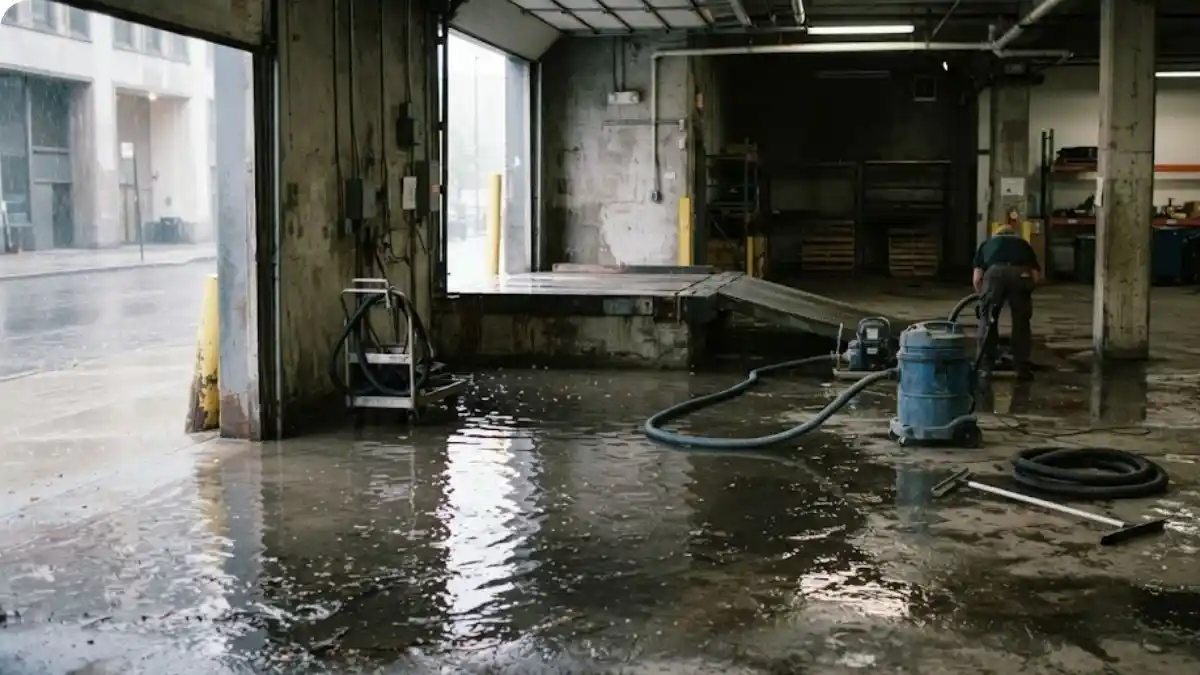
Loading docks are the most common storm-water entry point in Fairfax County's 1980s and 1990s office park and warehouse stock. Below-grade docks with channel drains at the dock pit can be overwhelmed when runoff rate exceeds drain capacity - water backs up in the channel and overtops into the building interior. This is a sudden, high-volume event: a three-inch hourly rain event can deposit several thousand gallons through a 20-foot-wide dock opening before building staff can respond. The water arriving through this pathway is typically Category 3 (rising groundwater and storm drain backflow are classified Category 3 under IICRC S500) and requires biohazard handling protocols alongside standard extraction. Call (571) 741-6292 for loading dock flooding events.
Storm Drain Surcharge and Basement Floor Drain Backup
When municipal storm drains reach capacity during a high-intensity event, the surcharge pressure in the system can push water back through floor drains in below-grade commercial spaces - the same mechanism as a sewage backup, but driven by stormwater rather than sanitary sewer. This is always Category 3 water. Mitigation requires temporary blocking of the affected floor drains after extraction, coordinated with the building's plumbing system. See Sewage Backup Cleanup for the full Category 3 handling protocol that applies in this scenario.
Envelope Intrusion Through Windows, Doors, and Roof Penetrations
Wind-driven rain during severe storm events forces water through exterior window frames, door thresholds, and roof penetrations - particularly in older commercial building stock where seals and flashing have deteriorated. This is typically Category 1 water. In mid-rise and high-rise buildings in Tysons and Merrifield, envelope intrusion may affect multiple floors when the water tracks down interior wall assemblies from upper-floor entry points. Moisture mapping is essential before demolition - wall cavity saturation extends significantly below the visible water entry point. Call (571) 741-6292 for envelope intrusion in commercial buildings.
Water Main Break - Commercial and Condo Impacts
Water main breaks in Fairfax County's aging distribution system - much of which dates from the 1960s and 1970s expansion period - can deposit significant water volumes into buildings and infrastructure before Fairfax Water can isolate and repair the break. A 6-inch water main rupturing below a commercial parking lot can undermine paving, migrate through foundation walls, and flood below-grade mechanical rooms within minutes of failure. The water from a clean municipal supply main is Category 1 at the break point, but degrades rapidly once it contacts soil and below-grade surfaces.
For businesses affected by a water main break on municipal property, documentation of the event timeline and damage extent is the foundation of any claim against the water utility. We log the arrival time, initial water volume assessment, moisture mapping results, and daily drying progress - the same documentation package that supports your commercial property insurance claim also supports a utility claim if the break was in municipal infrastructure. Call (571) 741-6292 and note that the source was a municipal main break when you call.
Debris Removal After Flooding
Storm flooding carries sediment, debris, and contaminants into commercial and residential spaces that clean-water events do not. Silt and clay deposits from storm water intrusion coat flooring, penetrate carpet backing, and infiltrate HVAC equipment. Debris removal before extraction is often necessary - sediment in standing water clogs extraction equipment and, if left in place after drying, creates ongoing air quality problems. We clear sediment and debris as part of the extraction process, bag contaminated materials per applicable waste handling rules, and document the debris removal for the insurance claim. Call (571) 741-6292.
Vertical Water Spread in Multi-Story Storm Events
In multi-story commercial buildings and condos, storm water that enters at the roof or upper floors does not stay there. Roof membrane failures during high-wind events allow water entry above suspended ceiling assemblies across a wide area; that water tracks down through the building's vertical chase ways - electrical conduits, plumbing chases, elevator shafts - and presents at multiple floors below the entry point. The floor where visible damage appears is rarely the only floor affected. Full-building moisture mapping from the top floor down is the correct initial step for any storm event with confirmed or suspected roof involvement. Call (571) 741-6292 for multi-floor storm water events in Tysons, Merrifield, Reston, and surrounding commercial corridors.
Storm Damage Insurance - What Applies
Storm damage coverage depends on the policy and the cause. Standard commercial property policies typically cover wind-driven rain intrusion and roof damage. Rising floodwater (storm surge, overland flow, or creek overflow) is typically excluded from standard policies and covered only by a separate flood policy - NFIP or private flood coverage. Water main break damage may be covered under your commercial property policy or may require a claim against the utility. Our documentation package is built to serve any of these claim paths. See Water Damage Insurance Claims for the full documentation process, and use our Business Downtime Calculator for commercial loss estimation. Call (571) 741-6292 to start extraction immediately - coverage determination runs in parallel.
Related Storm Damage Scenarios
Storm flooding often overlaps with other service scopes: if your basement flooded during the same event, see Flooded Basement Cleanup. If storm drainage carrying sewage contamination entered your space, see Sewage Backup Cleanup for Category 3 protocols. If the storm event included roof or window damage requiring emergency protection, see Emergency Board-Up.
Storm Flood Cleanup FAQ
-
Rising groundwater, overland storm flow, and storm drain surcharge are all classified Category 3 (black water) under IICRC S500 - they may carry pathogens, agricultural runoff, sewage from overwhelmed municipal systems, and industrial contaminants picked up in transit. This means porous materials that absorbed storm water should generally be removed rather than dried in place, and crew should use appropriate PPE during extraction. Wind-driven rain entering through an intact building envelope is typically Category 1. If you are unsure of the water source, assume Category 3 until our technician assesses. Call (571) 741-6292.
-
Overland flooding from creek overflow is classified as "flood" under standard insurance definitions, which means it is typically excluded from a standard commercial property policy and requires a separate flood insurance policy (NFIP commercial or private flood coverage). If your building was affected by wind-driven rain, roof damage, or storm drain surcharge (not direct creek overflow), the standard commercial policy may apply. The distinction between flood and non-flood water is something your adjuster determines - our documentation establishes the timeline and water entry mechanism to support that determination. Call (571) 741-6292.
-
Potentially yes. Visible water removal does not equal structural drying. If wall cavities, subfloor, or ceiling assemblies retained moisture after the visible water was removed, mold growth may already be underway in those hidden spaces - often without any surface indication for the first week to ten days. If the storm event involved Category 3 water and you did not perform antimicrobial treatment of structural surfaces, that is also an ongoing concern. A moisture mapping and assessment visit can determine whether residual moisture or contamination requires follow-up. Call (571) 741-6292 to schedule an assessment.