
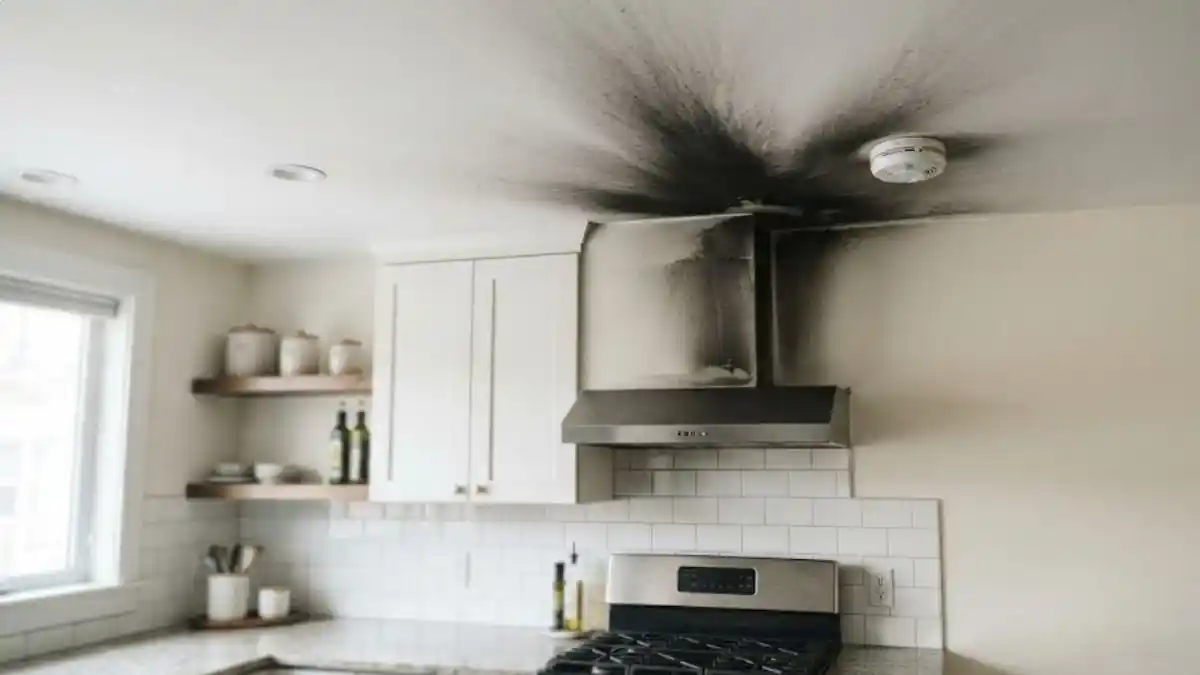
Smoke & Soot | Fire Damage | Condo
Smoke and Soot After a Kitchen Fire in Your Fairfax Condo: The Hidden Spread Problem
- Fairfax Restoration Crew
A kitchen fire in a Fairfax County condo - a grease fire that activates the range hood, or a food item that overheat while unattended - rarely stays in the kitchen. Smoke and soot particles are carried by air movement and by the HVAC return-air system to rooms throughout the unit, and in a multi-unit building, to adjacent units through shared penetrations and ductwork. The visible damage on kitchen surfaces tells only part of the story.
Wet Soot vs Dry Soot: Why the Difference Matters
Kitchen fires, particularly grease fires, produce wet soot - a sticky, tar-like residue with high surface adhesion that smears when wiped with dry materials. This is the opposite of what most people do instinctively: picking up a paper towel and wiping the stove. That motion embeds wet soot deeper into the surface and extends the contaminated area. Wet soot also has a very strong odor from the volatile organic compounds trapped in the oil-based particles, and those compounds continue to off-gas for days after the fire event if not chemically neutralized.
Dry soot from electrical fires or fast-burning paper and wood fires is a different material with different cleaning requirements. Dry soot is fine and powdery; it does not smear as readily as wet soot, but it distributes across surfaces by air movement far more widely. A smoldering electrical fire inside a wall cavity can deposit dry soot on surfaces in every room of the unit before the first visible flame appears. The correct first step with dry soot is HEPA vacuum before any wet cleaning - applying moisture to dry soot without vacuuming first spreads it across the surface and can set it permanently.
See Smoke & Soot Damage Cleanup for the complete three-soot-type cleaning protocol and Smoke & Soot First-Steps Checklist for what to do in the first two hours. Call (571) 741-6292 before touching any soot-affected surface.
The HVAC Spread Problem in Multi-Unit Buildings
If your HVAC system was running during or after the kitchen fire, smoke particles traveled through the return-air path and were distributed to every space served by your air handler. In many Fairfax County condo buildings - particularly the 1980s and 1990s mid-rise stock in Tysons, Merrifield, and Reston Town Center - air handlers serve multiple units from a shared return-air plenum. In that configuration, soot from your kitchen fire may have entered the shared return path and distributed to neighboring units whose occupants did not see any smoke or fire at all.
The first action when you discover a kitchen fire or smell persistent smoke is to shut the HVAC off. Not reduce the fan speed - off. Every minute the system runs after the fire event extends the soot distribution footprint. Once the system is off, open windows briefly to reduce airborne particle concentration, and call (571) 741-6292.
The Neighboring Unit Smoke Scenario
If you live adjacent to a unit where a kitchen fire occurred, you may find soot on your surfaces and a persistent smoke odor even though your unit had no fire involvement. This is smoke migration through shared penetrations, HVAC connections, and the gap between structural elements that exists in most multi-unit construction. Your HO-6 policy typically covers this as a sudden, accidental event not caused by your negligence - the same as any other covered loss. Your insurer may subrogate against the neighbor's liability coverage after paying your claim.
Document your unit's soot condition with photographs before any cleaning attempts. Notify your property manager. Notify your HO-6 insurer. Call (571) 741-6292 for soot assessment and cleaning. Do not attempt to clean soot yourself with household products - the wrong cleaning chemistry for the soot type in your unit can set the residue permanently and dramatically increase the cleaning cost.
Protein Residue: The Invisible Kitchen Fire Aftermath
Even kitchen events that do not produce visible char or heavy soot - an overheated pan that smoked but did not ignite, food that burned to the bottom of a pot - can deposit protein fire residue across kitchen surfaces. Protein residue is nearly invisible on most surfaces: a slight discoloration, a slightly tacky feel. But it produces a persistent odor that standard cleaning does not remove, and it bonds to surfaces at the molecular level. If you have a persistent cooking smell in your Fairfax condo that does not respond to normal cleaning, protein residue on kitchen surfaces and inside the range hood is the likely explanation. See Smoke Odor Removal for the neutralization protocol. Call (571) 741-6292.
Questions about your situation? Call (571) 741-6292 - Fairfax Restoration Crew serves commercial properties, condos, and multi-unit buildings across Fairfax VA, Fairfax County, and Northern Virginia.